Newcastle and Liverpool Draw 2–2 in Premier League Opener
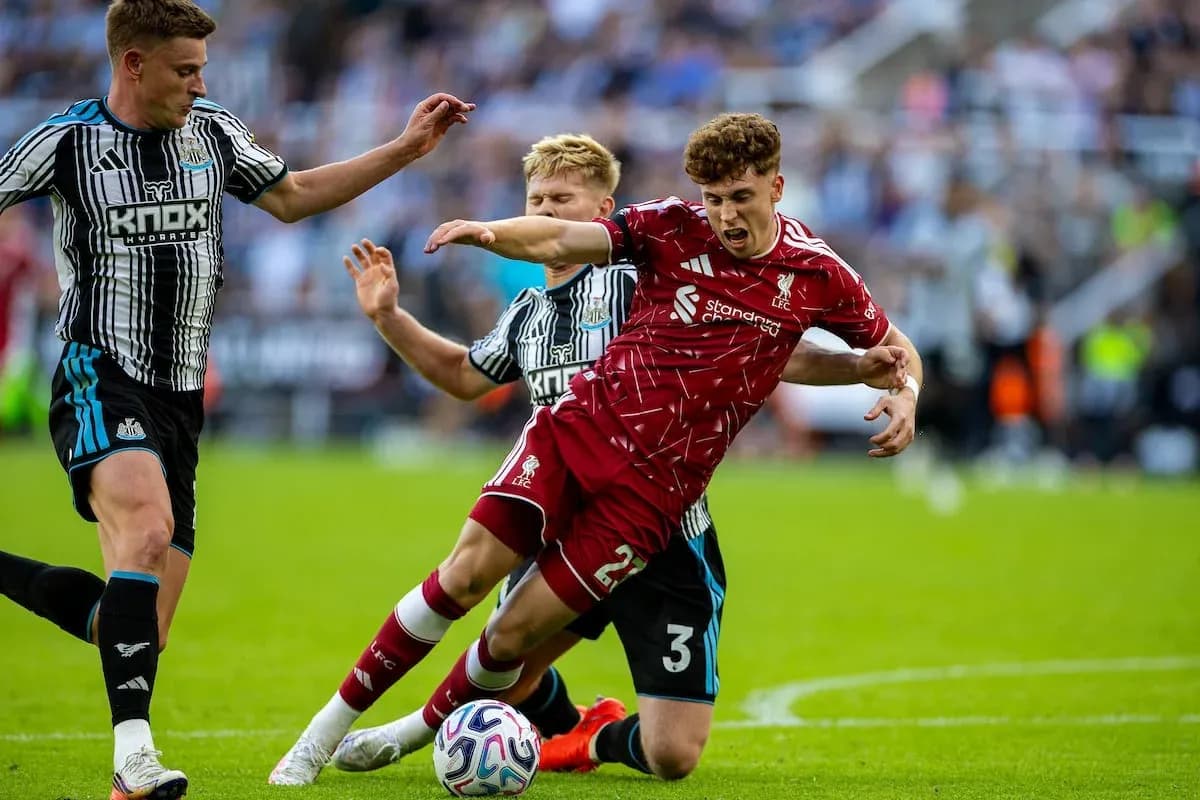
Under the grey Tyneside sky at St James’ Park, Newcastle and Liverpool opened their 2026 Premier League campaigns with a 2–2 draw that felt less like an early‑season sparring session and more like a statement of intent from two evolving projects.
I. The Big Picture – Two 4‑2‑3‑1s, one restless point apiece
Following this result, both clubs sit on 1 point from 1 match. Newcastle are 11th, Liverpool 10th, each with a goal difference of 0 after scoring 2 and conceding 2 overall. The symmetry of the table mirrors the symmetry on the pitch: both managers, Matthias Jaissle and Andoni Iraola, committed to a 4‑2‑3‑1 that revealed as much about their long‑term plans as it did about this single afternoon.
For Newcastle, this was a public unveiling of a new spine. L. Hornicek in goal, M. Thiaw alongside S. Botman at centre‑back, and a double pivot of S. Steur and L. Miley gave Jaissle a blend of youth, size and composure. Ahead of them, the trio of A. Elanga, Y. Wissa and H. Barnes supported W. Osula, who led the line as a mobile, pressing forward.
Liverpool answered with their own re‑imagined structure. Alisson remained the bedrock, but the defensive line of J. Frimpong, J. Jacquet, V. van Dijk and M. Kerkez was a new mix of pace, aggression and experience. In midfield, D. Szoboszlai and R. Gravenberch formed a technical double pivot, with R. Ngumoha, F. Wirtz and C. Gakpo operating behind A. Isak – a striking twist that underlined Iraola’s desire to weaponise verticality and fluid rotations in the final third.
Statistically, both sides emerge from Round 1 with identical attacking and defensive profiles. Newcastle have scored 2 and conceded 2 in total, averaging 2.0 goals for and 2.0 against at home. Liverpool, on their travels, have also scored 2 and conceded 2, with an away average of 2.0 goals for and 2.0 against. Neither team has kept a clean sheet yet, and neither has failed to score. It is an attacking baseline that promises chaos if defensive details are not tightened.
II. Tactical Voids – Absences and discipline
The absentees shaped the tactical canvas. Newcastle were without Joelinton and V. Livramento, both listed as missing through injury. Joelinton’s absence deprived Jaissle of a physically dominant, box‑to‑box presence in the left half‑space; it forced a greater creative and defensive burden onto Miley and Steur, and put more onus on Wissa to connect midfield and attack. Without Livramento, A. Dedic’s role at right‑back grew in importance as the primary outlet to combat Liverpool’s left‑sided threat.
Liverpool’s list was longer: C. Bradley, H. Ekitike, J. Gomez and G. Leoni all missed out. Bradley’s injury meant Frimpong’s attacking instincts had to be balanced by extra caution in transition. The absence of Gomez reduced Iraola’s flexibility in rotating his centre‑backs or shifting to a back three in possession. Ekitike’s injury removed a different type of forward option, making Isak’s role as the focal point even more central to Liverpool’s attacking plan.
Discipline-wise, the early‑season edges were visible. Newcastle’s yellow cards are spread almost evenly across the match: 20.00% between 16–30 minutes, 20.00% between 31–45, another 20.00% between 61–75, 20.00% between 76–90, and 20.00% between 91–105. That distribution suggests a side that defends aggressively in every phase, with late‑game bookings hinting at tired legs or tactical fouls to manage transitions.
Liverpool’s cautions are more front‑loaded. On their travels, 66.67% of their yellow cards have come between 16–30 minutes, with 33.33% between 76–90. Iraola’s press is clearly intense early on, and that aggression risks cheap fouls and early cards if opponents can play through the first wave. Neither side has seen a red card yet this campaign, but the volume and timing of yellows, especially for Newcastle, will be something to watch as the season matures.
III. Key Matchups – Hunter vs Shield, and the engine rooms
Even after a single game, certain individual battles define the trajectory of both squads.
For Newcastle, the “Hunter” label is shared. A. Elanga and J. Willock both sit among the league’s early top scorers with 1 goal each. Elanga’s 76 minutes from the left flank – 2 shots, both on target, 1 goal and 9 duels with 5 won – mark him out as a vertical threat who can both stretch the line and carry the ball through pressure. Willock, introduced from the bench, needed only 34 minutes to score, adding 2 tackles and 8 duels (3 won), underlining his box‑arriving profile and work rate.
Their effectiveness is framed by Liverpool’s “Shield”: V. van Dijk and J. Jacquet front a back line that, despite conceding twice, still carries the aura of control. Liverpool’s overall defensive numbers – 2 goals conceded in total, 2.0 against on their travels – are not yet alarming, but the fact that Newcastle found joy both through wide runners and late arrivals into the box will give Iraola tactical questions to answer about spacing in front of his centre‑backs.
In the “Engine Room”, the duel between creators and enforcers is already compelling. For Newcastle, Wissa and Miley blend industry with incision. Wissa, who appears among the league’s early assist leaders with 1 assist, also attempted 4 shots (1 on target), played 17 passes with 1 key pass, and contested 19 duels, winning 11. He is the archetype of Jaissle’s wide midfielder: relentless in the press, willing to drive inside, and capable of final‑third delivery.
Miley, just 19, offers composure: 36 passes at 83% accuracy, 2 key passes, 1 tackle, 1 block and 1 interception. He already sits in the league’s yellow‑card rankings with 1 booking, a sign that he is willing to foul to protect the structure when caught in transition.
Opposite them, R. Gravenberch is Liverpool’s metronome and connector. He, too, is among the early top assist providers with 1 assist, completing 47 passes at 91% accuracy, adding 1 tackle and 2 interceptions. His ability to receive under pressure, turn, and find the advanced trio of Ngumoha, Wirtz and Gakpo is central to Iraola’s blueprint. With D. Szoboszlai as a more vertical partner, Liverpool’s double pivot is built to both progress and counter‑press, but the concession of 2 goals on their travels suggests the spacing between them and the back four is still a work in progress.
IV. Statistical Prognosis – Two projects on parallel tracks
With only one league fixture played, any prognosis must be cautious, but the early statistical DNA is clear. Newcastle at home are averaging 2.0 goals for and 2.0 against, while Liverpool away are mirroring that with 2.0 for and 2.0 against. Neither side has yet demonstrated defensive solidity or a capacity to shut games down; both have, however, shown they can create enough to live with the league’s best.
Newcastle’s card profile – yellows spread across every major time band – hints at a side that will live on the edge of aggression, especially as Jaissle leans into a high‑energy, front‑foot style. Liverpool’s early‑game caution spike between 16–30 minutes suggests Iraola’s press can overheat if opponents escape the initial trap.
Without explicit xG data, the eye is drawn instead to the balance of chances and the quality of the creators. With Wirtz and Gravenberch orchestrating for Liverpool, and Elanga, Willock, Wissa and Osula combining for Newcastle, both teams look more likely to win matches 3–2 than 1–0 in the short term.
Following this result, the table says parity. The underlying patterns, though, whisper of two ambitious sides still discovering how ruthless they can be – and how much risk they are willing to carry to get there.