
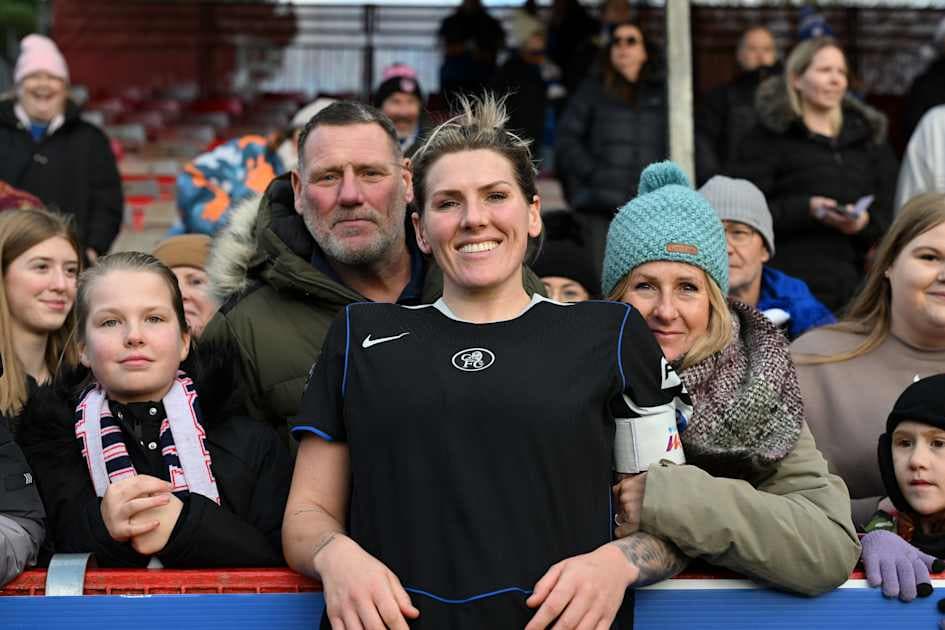
Millie Bright's Chelsea Farewell: A Captain's Legacy
On Saturday at Stamford Bridge, when Chelsea face Manchester United in their final WSL game of the season, the result will share the stage with something far bigger. This is Millie Bright’s last dance in blue. Twelve years of sweat, silverware and steel distilled into one long goodbye.
There will be noise, of course. There always is here. But as the captain walks out, there will also be a lump-in-the-throat silence that no anthem can quite cover. No player has been stitched so tightly into the fabric of Chelsea Women as Bright. Nobody has lived every step of the club’s rise quite like she has.
Twenty trophies. Three hundred and fourteen appearances. Nineteen goals from the back line. Every major piece of silverware in the club’s history has her fingerprints on it. Her exit is not just the end of a chapter; it’s the closing of the first great volume of Chelsea’s modern story.
Leaving as Stamford Bridge becomes home
Next season, Chelsea Women will play all their WSL home matches at Stamford Bridge. The move has been years in the making, pushed hard by senior voices inside the dressing room. Bright has been one of the loudest and most persistent.
She fronted the ‘Never Done’ campaign that announced the shift to SW6. She wanted this stage for her team-mates, this visibility, this sense that Chelsea Women belong at the club’s main address, not just on its outskirts.
Ironically, she will not be there to enjoy it week in, week out. She knows what some people will say: shame she never got to play all her home games there. But Bright doesn’t sound like a player nursing regrets. She has Kingsmeadow etched into her memory and sees Stamford Bridge as the platform for those who follow.
She talks about a “new era of Chelsea” with the conviction of someone who has done her bit and is content to pass the baton on. That, in itself, tells you everything about how she views leadership: keep pushing the club forward, then step aside when your work is done.
A serial winner learning to look back
Bright turns 33 this year. She has been at the heart of a revolution, both for Chelsea and the women’s game more broadly. For much of that time, she has been defined by football, and she knows it.
She calls herself a “serial winner” and, for once, allows that label to stand. The medals and memories demand it. Yet even in these final days as a player, she admits she is not good at self-praise. The instinct is always to move on to the next challenge, the next game, the next trophy.
Retirement forces a different rhythm. It demands reflection. She talks about needing to appreciate what she has done, what the sport has given her, and what she has given back. That is not vanity; it is a necessary reckoning for someone whose life has been set to the drumbeat of training schedules and matchdays.
Football, she says, has been her biggest lesson. It has hardened her, shaped her, taught her to understand emotions and confront them. It has given her the thick skin required to survive at the top, but also the perspective to know that the game is never just a game.
To the kids coming through, her message is blunt: don’t be naive. Football is far more than 90 minutes and a ball. It will test you, thrill you, break you, rebuild you. Enjoy every second, because it disappears faster than you think.
The weight of goodbye
Bright insists this is the right time to walk away. Her body and mind have carried the load for long enough. That doesn’t soften the blow of leaving the club that has been her world for more than a decade.
The hardest part, she admits, is saying goodbye to her “Chelsea family”. The team-mates who have carried her through tough moments, often without realising it. She names them one by one, each a thread in the tapestry of her career.
- Sam Kerr.
- Guro Reiten.
- Erin Cuthbert.
- The ones who came before: Katie Chapman, the “sister” who took her under her wing.
- Gemma Davidson.
- Claire Rafferty.
- Drew Spence.
- Jodie Brett.
- Rosella Ayane.
- Magdalena Eriksson.
- Fran Kirby.
- Maren Mjelde.
These are not just colleagues. They are anchors. They are the people she will miss in the quiet moments, when the routine has gone and the WhatsApp messages slow down. She knows they will stay in touch, knows that when they meet, the conversation will pick up as if no time has passed. But she also knows that nothing quite replaces the daily grind of a dressing room shared.
That is the real wrench. Not the roar of the crowd, but the everyday lives lived together behind closed doors.
Life after the whistle
Bright is not stepping into a void. She is stepping into a different kind of work, and a different kind of life.
She will remain a Trustee of the Chelsea Foundation and become an ambassador for the club. The badge will still sit on her chest; the responsibilities will simply change. She will move from the pitch to the platform, from tackling strikers to shaping futures.
Even so, the shift will be jarring. Professional footballers live inside a rigid structure: training, meetings, travel, matches. Days are mapped out to the minute. Bright admits she loves that. She clings to routine, hates change.
So she has prepared. She has already bought a whiteboard, started writing out new schedules. Nine o’clock this. Ten o’clock that. A different kind of day, but still a day with purpose.
Her retirement from England taught her one crucial lesson: only the player can decide when it is time. Mentally, she has pushed and pushed for years. Now she wants to sit back, at least for a while, and truly savour the wins instead of sprinting past them.
Family has driven this decision as much as football. She has been away from home for 12 years. When life has hit hard, her people have often been far away. That takes its toll. The pull towards home has grown stronger than the pull towards another season.
“My family are everything,” she says. That is where she is heading now.
Horses, holidays and the moments she missed
Bright’s life is not empty without football. Far from it. She has passions waiting for her, ready to be reclaimed.
The horses come first. They bring their own discipline: early starts, daily care, a different kind of responsibility. It is still a schedule, still structure, but on her terms. It excites her.
So does the simple idea of living a little. For years, she has turned down family events, missed celebrations, sacrificed holidays. Always a game, always a camp, always another commitment. That is the price of elite sport, and she has paid it without complaint.
Now she wants those moments back. Or at least, she wants to stop losing new ones.
Recently, she made it to her nephew’s birthday meal. It was the first one she had ever been able to attend. A small thing, perhaps, but it hit her. This is what she has been missing. This is what she wants more of.
Time with family. Time with friends. Time without the constant calculation of whether a night out or a weekend away might compromise performance.
She is not walking away from ambition. She is walking towards a different version of it.
A final roar at the Bridge
Saturday will not be a quiet farewell. It will be loud, emotional, messy. Just as it should be.
Chelsea will chase a result against Manchester United, because that is what Bright’s Chelsea always did. Compete. Fight. Win. But as the clock ticks down, eyes will drift to the captain, to the defender who has thrown herself in front of everything for this club.
When the whistle goes, the chapter closes. The club moves into its full-time home at Stamford Bridge. The next generation steps into the light. The story carries on.
Millie Bright, the serial winner, the standard-setter, the captain, walks away knowing she has kept her promise: to leave Chelsea further forward than she found it.
The question now is not what she leaves behind. It’s what she does next, once the roar of the Bridge fades and the only sound is the early-morning rustle of hay in a stable somewhere far from SW6.





