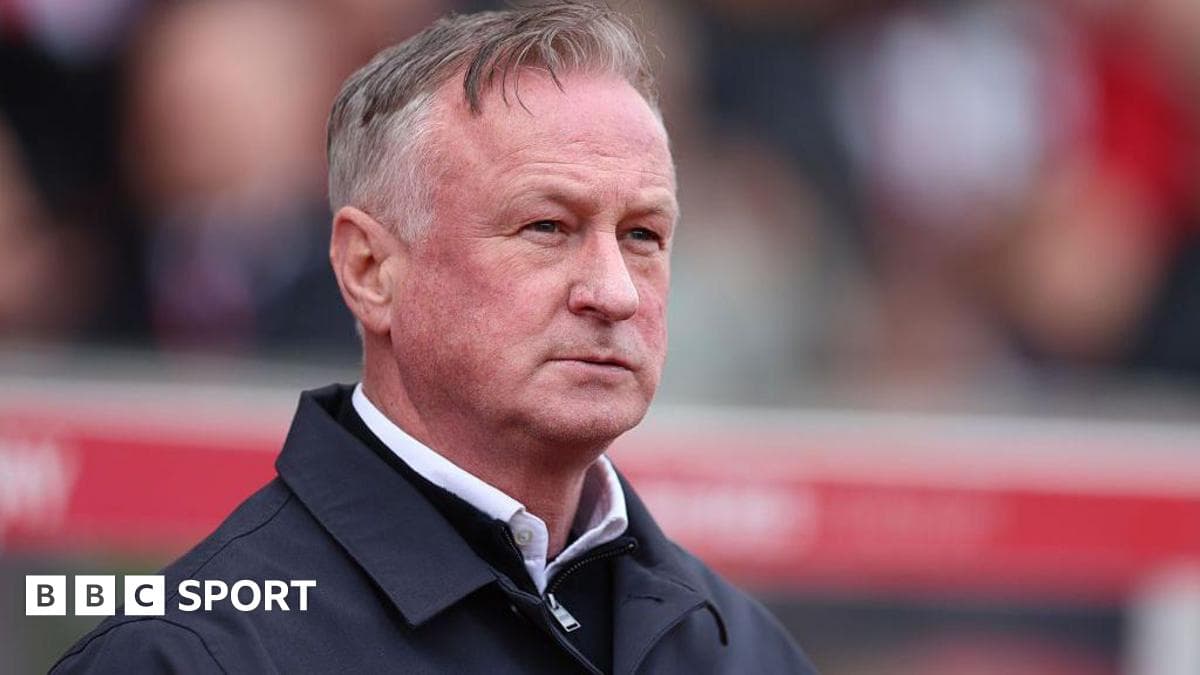
Michael O’Neill Chooses Northern Ireland Over Club Management
Michael O’Neill has turned his back on club management – for now – and nailed his colours firmly to the Northern Ireland mast.
After three intense months juggling Blackburn Rovers and his country, the 56-year-old has chosen Windsor Park over Ewood Park, long-term international ambition over the weekly grind of the Championship.
Club or Country? O’Neill makes his call
Appointed interim Blackburn boss in February, O’Neill walked into a relegation scrap with the understanding it was a short-term rescue mission. Fifteen games later – five wins, five draws, five defeats – he had done just enough. Rovers stayed up, finishing 20th in the second tier and avoiding the trapdoor.
All the while, he kept repeating the same message: he could not do both jobs permanently. At some point, one would have to give.
That moment has arrived.
“Following discussions with the club, Michael has decided to continue his long-term commitment to his role as Northern Ireland head coach, with a focus on leading the national team towards qualification for the Uefa European Championships in 2028,” Blackburn confirmed in a statement.
O’Neill’s own words carried the tone of a man who had enjoyed the challenge, but knew where his heart lay.
“Blackburn Rovers is a historic football club with a proud tradition and passionate supporters. I have thoroughly enjoyed my time working with the players, staff and everyone around the club,” he said, before drawing a clear line.
“After careful consideration, I have decided that my long-term focus must remain with Northern Ireland and the journey towards the European Championship campaign ahead.”
Blackburn will now start the search for a new permanent head coach, with the club saying updates will be announced “in due course”. They at least have time on their side before the 2026-27 campaign kicks off.
A second Northern Ireland project gathers pace
For Northern Ireland, this is a win that goes beyond one man’s job title. It is the confirmation that the architect of their modern high points is staying to finish what he has started again.
Across his two spells in charge, O’Neill has managed 104 games, with 38 wins, 23 draws and 43 defeats. The numbers only tell part of the story. He was the man who dragged a modest squad to Euro 2016, their last appearance at a European Championship. Now he has been backed to lead another charge towards Euro 2028.
The Irish FA’s response left no room for doubt about how they view his decision.
“We are delighted Michael has decided to stay on as Northern Ireland manager. He has built another exciting squad of players and we now look forward to building on this momentum as we plan for both the Uefa Nations League campaign this autumn and the subsequent qualifiers for Euro 2028 with Michael at the helm,” read their statement.
The relief among supporters will be just as strong. When O’Neill hinted in March he would “return to the status quo” for the June fixtures, it sounded like continuity. When he later admitted in April that a decision was still to be made, alarm bells began to ring. Now the uncertainty has been cut short, and the focus can swing back to football.
A young squad, a high ceiling
Like his first spell, O’Neill inherited a Northern Ireland side in difficulty from Ian Baraclough. They failed to reach Euro 2024 and missed out on this year’s World Cup, but the trajectory has changed. Performances have sharpened. The football has more ambition.
The age profile tells its own tale. The starting XI that lost to Italy in their World Cup play-off in March had an average age of just 22.5 – the country’s second-youngest team on record since World War Two. And that was without three key figures: Conor Bradley, Dan Ballard and Ali McCann.
Even with those absentees, the squad looks built for the long haul. Young, energetic, and with room to grow.
That is the project O’Neill has chosen to protect.
The road ahead: Guinea, France, then Group B2
The next steps are already mapped out. Northern Ireland face friendlies in June against Guinea in Cadiz and France in Lyon, valuable tests for a squad still learning its craft together. Then comes the Nations League in September, where O’Neill’s side will meet Hungary, Georgia and Ukraine in Group B2.
With the managerial question settled early, preparations for those fixtures can be detailed rather than distracted. Training plans, tactical tweaks, squad evolution – all under the same voice, the same vision.
For the Irish FA, there is another quiet truth. Had O’Neill walked away, this would have been a very attractive job for a new candidate. The squad is younger, the mood brighter, the foundations stronger than when he returned in 2022. Instead, they keep the man who laid those foundations and avoid any upheaval on the eve of another campaign.
Blackburn now step into a summer of interviews and shortlists. Northern Ireland step into a summer of planning.
O’Neill has chosen the international stage again. The question now is whether this second act can carry them back to a major tournament, just as it did in 2016 – or even beyond.