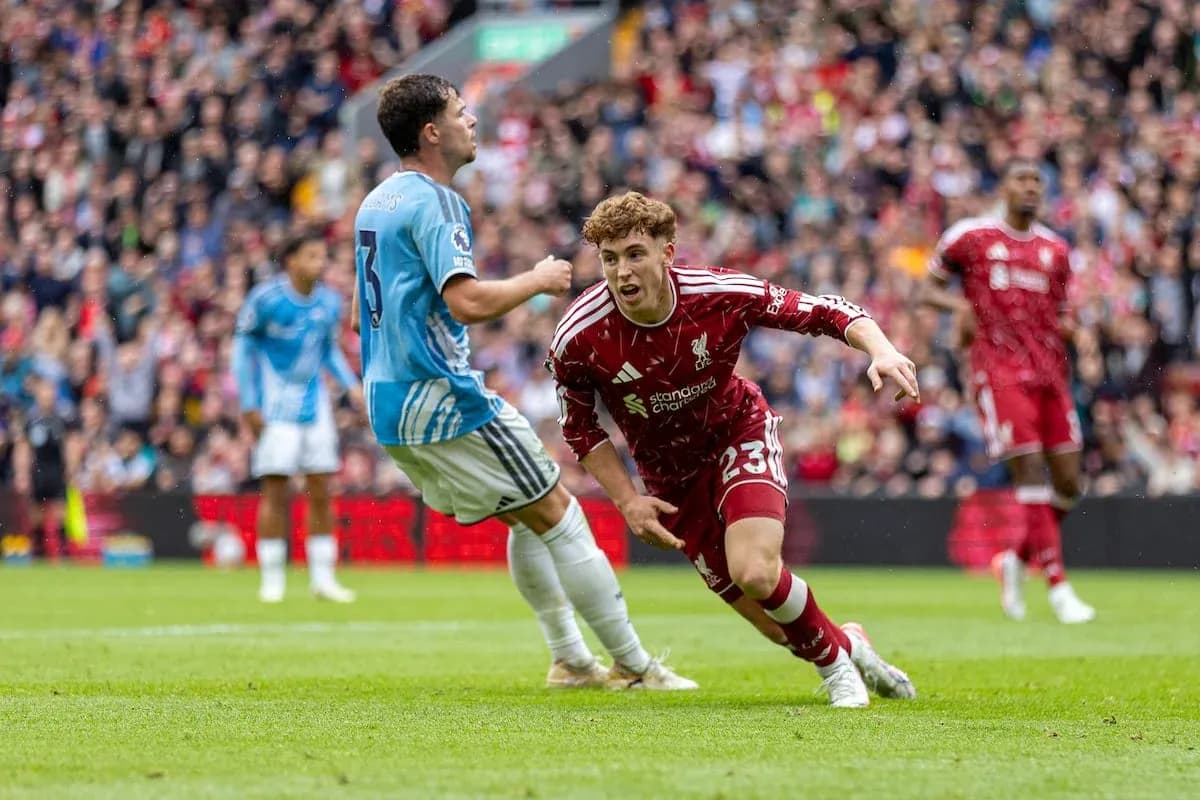
Liverpool vs Nottingham Forest: Tactical Analysis of a 2–2 Draw
Anfield felt oddly restless at full time. Liverpool had chased the game, flipped its rhythm, and still walked away with only a point. A 2–2 draw against Nottingham Forest keeps Andoni Iraola’s side unbeaten, but after two matches of the Premier League season, their story is one of promise without control.
Heading into this game, Liverpool sat 13th with 2 points from 2 matches, their overall goal difference locked at 0 after scoring and conceding 4. At home they had now played 1, drawn 1, with 2 goals for and 2 against. The numbers tell of balance; the performance revealed imbalance.
Iraola doubled down on his 4-2-3-1, a shape already used in both league outings. Alisson sat behind a back four of Jeremie Frimpong, J. Jacquet, Virgil van Dijk and Milos Kerkez. Ahead of them, Dominik Szoboszlai and Alexis Mac Allister formed the double pivot, with a high-technical line of three — Cody Gakpo, Florian Wirtz and Víctor Muñoz — supporting Alexander Isak.
The absentees framed the risk. Without S. Bajcetic, J. Gomez and G. Leoni through injury, Iraola had no natural destroyer or extra defensive cover to stiffen the spine. F. Chiesa and H. Ekitike, both missing, robbed him of a direct, vertical threat from the bench. Even H. Elliott, left out by coach’s decision, would have been a useful tempo shifter between the lines. The bench was rich in ball-players — Ryan Gravenberch, Wataru Endo, J. McConnell — but light on pure defensive insurance.
Opposite him, Oliver Glasner’s Nottingham Forest arrived in their now-familiar 3-4-2-1, and their league position — 15th with 1 point, goal difference -1 — masked a side that had already shown sharp edges. Overall, Forest had scored 2 and conceded 3 in 2 matches, with both of their goals coming on their travels, where they averaged 2.0 goals for and 2.0 against. Away from home, they were expansive and dangerous, even if structurally loose.
The back three of Murillo, Nikola Milenkovic and Cunha was screened by a combative midfield line: Neco Williams and Ola Aina wide, with Xaver Schlager and James McAtee central. Ahead of them, Morgan Gibbs-White and Dan Ndoye buzzed around lone striker Igor Jesus. The major absentee was I. Sangare, whose calf injury stripped Forest of their most natural ball-winner and screen. N. Savona’s knee injury further reduced Glasner’s options in the engine room.
The first half belonged to Forest’s game plan. Gibbs-White, already with 1 goal and 1 assist in total this campaign and an overall passing accuracy of 82%, drifted into the half-spaces, drawing van Dijk and Jacquet into uncomfortable decisions. His duel numbers — 21 overall with 10 won — underline how often he engaged Liverpool’s midfield and back line physically as well as technically. With Aina pushing high from the right, Forest repeatedly created overloads on Kerkez’s side.
Aina’s season profile explains the edge to those duels. He had already collected 2 yellow cards in 2 appearances, committing 3 fouls but winning 10 of 20 duels. His willingness to step out and engage carried risk, but it also pinned Liverpool back. Even without a red card to his name, his disciplinary history this season is a warning light for Forest: aggression is an asset, but it walks a fine line.
Liverpool’s structure in possession was ambitious but fragile. Szoboszlai and Mac Allister tried to dictate from deep, but with full-backs pushing high and Wirtz and Gakpo coming inside, transitions were perilous. The season-long numbers underline the pattern: overall, Liverpool have scored 4 and conceded 4, averaging 2.0 goals for and 2.0 against both at home and away. They have yet to keep a clean sheet in any venue, and have not failed to score either. Every game is becoming a shootout.
Going forward, though, there is a clear attacking hierarchy. Gakpo, with 1 goal and 1 assist in total and an overall rating of 7.25, is already the creative reference, producing 5 key passes and 3 drawn fouls. Wirtz, also on 1 assist, adds subtlety between the lines, completing 81% of his passes and attempting 4 dribbles. Muñoz brings directness — 1 goal, 1 penalty won, 18 duels contested — and a streak of controlled chaos that forces mistakes.
Isak is the spearhead, his 1 goal from 5 shots and 3 on target backed by 7 duels won from 14. He provides depth, but he still relies on the trio behind him to break the last line. The tactical question for Iraola is how to keep that front four on the pitch without leaving the double pivot exposed.
Forest’s offensive threat is more vertical. Ndoye, with 1 goal and 5 dribbles attempted, attacks space aggressively. Gibbs-White stitches everything together, while Igor Jesus occupies centre-backs and opens channels for underlapping runs from McAtee and Schlager. On their travels they average 2.0 goals for, and this performance at Anfield fit that pattern: direct, incisive, and opportunistic.
Defensively, both sides are works in progress. Liverpool’s overall goal difference of 0 (4 for, 4 against) is built on a back line still learning each other’s movements. Frimpong and Kerkez have each already been booked this season, while Ronald Araújo, used from the bench in earlier games, has 1 yellow card and 2 successful blocks to his name. There is bite and recovery pace, but not yet the collective timing to compress space without being exposed.
Forest, meanwhile, have conceded 3 overall, with 1 at home and 2 away. Their away average of 2.0 goals against reflects a back three that can be stretched when wing-backs are caught high. Without Sangare, Schlager has to cover more ground, and yellow-card patterns suggest Forest’s intensity spikes early and after the break: 25.00% of their yellows come between 16–30 minutes, another 25.00% between 31–45, and 50.00% between 46–60. That mid-game surge in aggression is both a weapon and a liability.
From a disciplinary standpoint, Liverpool’s own yellow-card distribution is more evenly spread, with 28.57% of their bookings arriving between 16–30 minutes, another 28.57% between 46–60, 14.29% between 61–75, and 28.57% in the 76–90 window. They do not explode at one specific phase; instead, their intensity and risk-taking persist across the match.
In the “Hunter vs Shield” matchup, Liverpool’s attacking core — Gakpo, Isak, Muñoz and Wirtz — has enough variety to trouble any back three, especially one that concedes 2.0 goals on their travels. Forest’s shield is system-based rather than personnel-based: compactness, numbers behind the ball, and counter-pressing from Gibbs-White and Ndoye. When that first line is broken, however, Milenkovic and Murillo can be dragged into wide channels they do not enjoy.
The “Engine Room” battle is subtler. Mac Allister and Szoboszlai offer more on the ball than off it, while Schlager and McAtee are more balanced but lack Sangare’s pure destructive profile. Over 90 minutes, that produced a game that swung rather than settled, with both midfields able to create but neither able to truly suffocate.
Statistically, the prognosis for both is clear. Liverpool, with 2 draws from 2 and a consistent 2.0 goals for and against in every environment, are an attacking force searching for defensive equilibrium. Forest, with 1 point, 2 goals scored and 3 conceded, are a counter-punching side whose best football appears on their travels, but who must tighten their structure if they are to turn dangerous performances into wins.
Following this result, the narrative is less about league position and more about identity. Liverpool look like a high-ceiling, high-variance side, where every fixture threatens to become a track meet. Forest, under Glasner, are evolving into an away-day spoiler with enough quality — especially in Gibbs-White and Ndoye — to hurt bigger sides.
The tactical lesson from Anfield is simple: both teams can hurt you, both can be hurt. Until one of them learns to control games without sacrificing threat, their seasons will be defined by nights like this — breathless, entertaining, and ultimately unresolved.