Levski Sofia vs AEK Athens: Tactical Stalemate in UEFA Play-offs
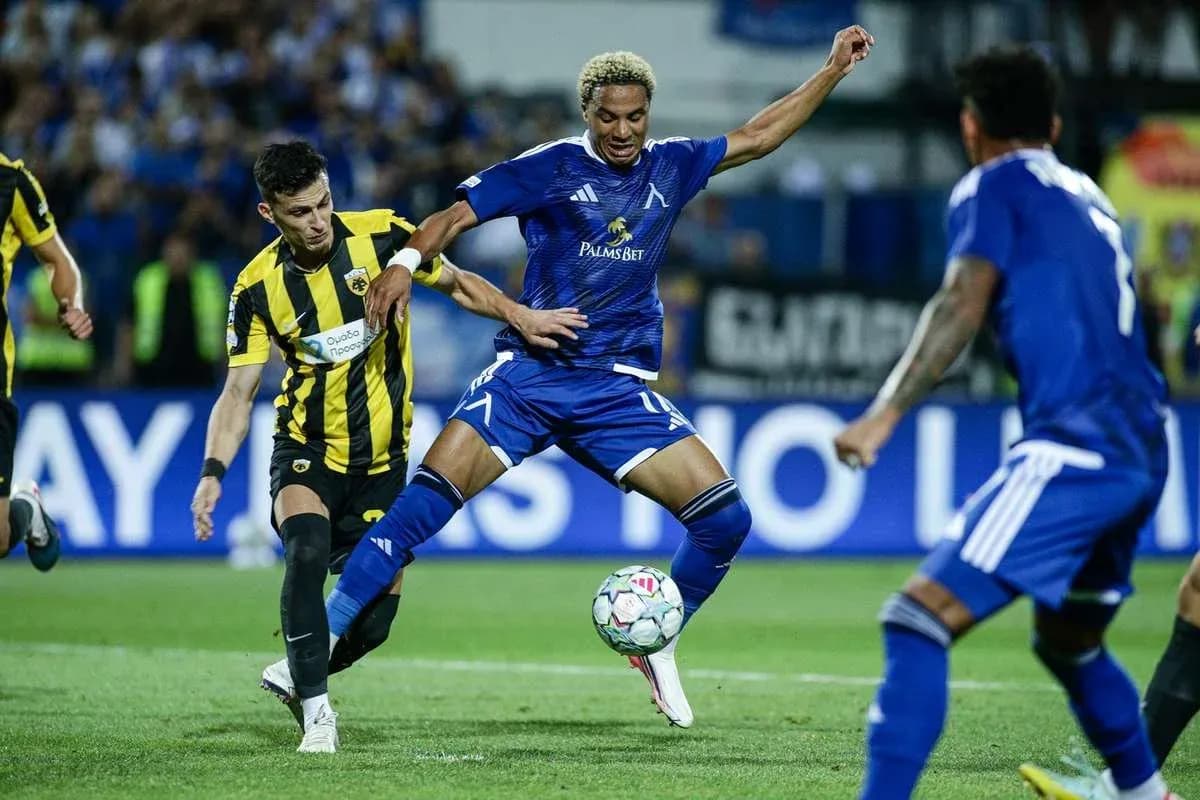
Levski Sofia and AEK Athens FC played out a goalless but tactically rich draw at Georgi Asparuhov Stadium, a first-leg style contest in the UEFA Champions League Play-offs that was defined more by structure and control than by penalty-box chaos. The 0-0 scoreline reflected two disciplined blocks cancelling each other out, with Levski edging possession at 52% and volume (15 total shots to 12) but unable to turn their territorial advantage into clear chances. AEK accepted a slightly more reactive role, relied on their defensive line and double pivot, and looked to play vertically through their front two when the opportunity arose.
Levski set up in a 4-2-3-1 under Julio Velazquez, and the shape was clear in both phases. In build-up, the centre-backs K. Dimitrov and N. Serafimov split, with M. Moubarik often dropping between or just ahead of them to create a three-man base, while Maicon stayed slightly higher as the more progressive of the double pivot. Full-backs A. Neves and A. Centelles provided width, allowing the line of three – A. Oko-Flex right, Serginho central, Everton Bala left – to operate in more interior pockets around Reinaldo.
The passing numbers underline Levski’s methodical approach: 485 total passes with 428 accurate at an 88% completion rate. They circulated the ball patiently, seeking to move AEK’s 4-4-2 block laterally before threading passes into the half-spaces. However, their shot profile reveals the limits of that possession. Of 15 total shots, only 6 came from inside the box and just 3 were on target, with 4 attempts blocked. AEK’s compactness between the lines meant that much of Levski’s final-third play was forced into lower-quality efforts from outside (9 shots from distance).
AEK, in Marko Nikolic’s 4-4-2, were structurally orthodox but very disciplined. The back four of L. Rota, H. Moukoudi, F. Relvas and S. Pilios stayed narrow, with the wide midfielders A. Koita and L. Majer (before his substitution) tracking Levski’s full-backs to prevent easy overloads on the flanks. Inside, K. Kairinen and R. Marin formed a screening pair in front of the centre-backs, primarily focused on closing central lanes into Serginho and denying Reinaldo clean touches between the lines.
In possession, AEK were more direct. With 453 passes and 394 accurate (87%), they were tidy enough when they chose to keep the ball, but the attacking plan leaned towards early passes into the front pair Zini and L. Jovic, or quick switches to the wings to exploit any advanced positioning from Levski’s full-backs. Their 12 shots were slightly fewer in number but not dramatically inferior; 5 came from inside the box, yet only 1 tested the goalkeeper, suggesting that while they reached advanced zones, the final action lacked precision.
Both goalkeepers were relatively underworked, reflecting the defensive control on show. S. Vutsov (Levski Sofia) made 1 save, his back line generally protecting the central corridor well and forcing AEK’s forwards into rushed or off-target finishing. At the other end, T. Strakosha (AEK Athens FC) was the busier of the two, registering 3 saves. He dealt confidently with Levski’s limited on-target efforts, and his handling under pressure, especially on shots from range and the occasional cross, helped AEK maintain their clean sheet without panic.
The foul count – Levski 8, AEK 17 – hints at the different defensive approaches. Levski’s lower foul total aligns with a more positional, zonal defence, preferring to delay and channel rather than step into risky duels. AEK’s 17 fouls reflect a more aggressive use of tactical fouling, especially as Levski tried to accelerate through the middle third. That edge in physicality helped AEK disrupt Levski’s rhythm but also underscored how often the visitors were forced to defend facing their own goal.
Substitutions became a key tactical lever in the second half as both coaches sought marginal gains without breaking their structures. At 57', AEK adjusted their midfield and attack: L. Majer (OUT) for P. Mantalos (IN) added more playmaking intelligence between the lines, while L. Jovic (OUT) for B. Varga (IN) refreshed the front line with a more mobile, channel-running profile. This subtly shifted AEK’s threat from back-to-goal combinations to more diagonal runs behind Levski’s defence, though the end product still fell short.
Levski’s response was staggered and aimed at injecting dynamism. At 67', A. Oko-Flex (OUT) for J. Perea (IN) signalled a desire for more direct running and penalty-box presence from the right side. Later, at 79', Everton Bala (OUT) for M. Soula (IN) and Reinaldo (OUT) for A. Mitkov (IN) effectively refreshed the entire left and central attacking channels, trading some familiarity in the system for fresh legs and perhaps more verticality. In the closing minutes, Velazquez also rotated his right-back and midfield: A. Neves (OUT) for S. Hevertton (IN) at 88' and Maicon (OUT) for S. Stoyanchov (IN) at 89' suggested a final push with new energy, but AEK’s structure held.
Nikolic mirrored that late-game management on 81', withdrawing both wide midfielder and striker: A. Koita (OUT) for M. Gacinovic (IN) and Zini (OUT) for O. Zubkov (IN). This double change nudged AEK towards a slightly more conservative, control-oriented midfield while keeping a counter-attacking outlet. The effect was to further compress central spaces and make it even harder for Levski to progress cleanly between the lines in the final stretch.
Set pieces were another subtle battleground. Levski earned just 1 corner compared to AEK’s 2, a small but telling sign of how rarely they were able to pin the visitors deep and sustain pressure. Offside figures – Levski 0, AEK 1 – reinforce the idea that AEK were more willing to push the last line and risk runs in behind, whereas Levski’s attacks were more about patient construction in front of the block.
From a broader tactical lens, this 0-0 fits the profile of a Play-offs tie where both sides prioritised staying in the contest over taking reckless risks. Levski’s slightly higher possession and pass accuracy underline their role as the more proactive team, but their inability to convert circulation into high-quality chances inside the box will be a concern going into the next leg. AEK, meanwhile, will be satisfied with how their 4-4-2 block functioned, how effectively they limited Levski to 3 shots on target, and how their in-game adjustments maintained defensive stability while preserving a modest counter-attacking threat.
Ultimately, the match was a study in controlled caution: two well-drilled structures, marginal differences in approach, and defences that consistently had the final word.