Kinsky's Redemption: From Madrid Nightmare to Premier League Hero
Antonin Kinsky walked off in Madrid like a man being ushered out of the elite game. Hooked after 17 minutes, two errors, 2-0 down to Atletico in a Champions League last-16 tie, he looked less like Tottenham’s future and more like a cautionary tale.
Peter Schmeichel, who knows better than almost anyone how brutal that position can be, called it a moment that would follow Kinsky for the rest of his career. The comparison with Loris Karius came quickly and mercilessly. A big stage, a bad night, a reputation shredded in real time.
Plenty assumed that was it at the top level. A name filed away under “what might have been”.
Kinsky had other ideas.
From Madrid nightmare to Leeds defiance
Since stepping back in for the injured Guglielmo Vicario against Sunderland last month, the 23-year-old has been quietly rebuilding himself. A few sharp saves, calm work with the ball at his feet, a standout free-kick stop deep into stoppage time in the 1-0 win over Wolves — the foundations were there. Solid, encouraging, but not yet enough to erase the Metropolitano from anyone’s mind.
He needed a night where he didn’t just keep goal. He needed a night where he changed a result.
Against Leeds United, he finally got it. Twice.
The 1-1 draw will be remembered for its tension at the bottom of the table, for Tottenham clinging to a two-point cushion over West Ham United. But threaded through it was the story of a goalkeeper refusing to let one catastrophic evening define him.
The first big moment arrived in the 21st minute. It might not make every highlight reel, yet it spoke directly to the doubts that had stalked Kinsky since October’s Carabao Cup defeat at Newcastle United, when he misjudged two wide deliveries and conceded twice from crosses.
Leeds swung another one in. Brenden Aaronson, from the right. Joe Rodon, the former Spurs defender, peeled away at the back post and met it cleanly, driving a header low toward Kinsky’s bottom-left corner. This was exactly the sort of situation critics said unnerved him.
Kinsky read it early, exploded down and across, and then did something only the best do under that kind of pressure: he didn’t just block it, he controlled it. A sharp dive, a claw away from danger, then a gather. Attack over. Anxiety, for a moment, silenced.
By any standard, it was a world-class save. On this night, it was only his second-best.
The save of a season
Deep into stoppage time, with Spurs hanging on and every point a lifeline, Leeds came again. The clock had ticked into the eighth added minute when Sean Longstaff, eight yards out, met the ball with a thumping strike that looked destined to rip the roof off the net and Tottenham’s survival hopes with it.
This was the moment that breaks goalkeepers. Legs heavy, lungs burning, minds racing. One misstep, one flinch, and the ball is in.
Kinsky held his ground.
Matt Pyzdrowski, the former professional goalkeeper and specialist analyst, saw more than just reflexes. He saw a keeper thinking clearly in chaos.
“As the ball was played in behind, he resisted the natural temptation to rush out and close the angle,” Pyzdrowski explained. Kinsky stayed connected to the turf, shuffling in short, precise steps, edging toward his near post while never losing the line of the ball. With Micky van de Ven scrambling across to cover, Kinsky understood his job: don’t overcommit, don’t dive at shadows, stay balanced, be ready.
His set position was textbook. Feet shoulder-width apart. Chest over his knees. Hands around waist height, free to react. That stance did two things at once — it protected the upper half of the goal with his hands and left his legs ready to shut down the bottom, a shape reminiscent of David de Gea at his best for Manchester United.
Drop lower and you lose the spring. Widen the base and you block your own route to the ball. Kinsky did neither. He stayed compact, upright, coiled.
So when Longstaff’s shot came, vicious and rising, the distance his hands had to travel shrank to a split-second twitch. He lined them up with the ball and, somehow, still found the power to punch his right hand up and turn it onto the bar.
“Frankly, how ridiculous it was that he could still generate the power to drive his right hand upward to make the save — which is not something every goalkeeper would have been capable of producing in that moment,” Pyzdrowski said.
The ball cannoned off the woodwork and out. Tottenham stayed level. Tottenham stayed two points clear of West Ham.
Season-altering? It may yet prove so.
Not just a shot-stopper
That save underlined what has become increasingly obvious: Kinsky is not “every goalkeeper”.
His distribution already suits Roberto De Zerbi’s demands. He is comfortable in possession, brave enough to take the extra touch, accurate enough to break lines. Spurs can build from the back with him; they can draw opponents in and play through them.
But without the mentality to withstand what happened in Madrid, none of that matters. Plenty of talented keepers have never come back from a night like that. Karius is the modern reference point, a Champions League final that haunted every subsequent appearance.
Kinsky has refused to be the sequel.
From the moment he returned to the side, he has carried himself like someone determined to wrestle his story back. No sulking, no shrinking. Just a steady accumulation of good decisions, brave moments, and now, one of the saves of the Premier League season.
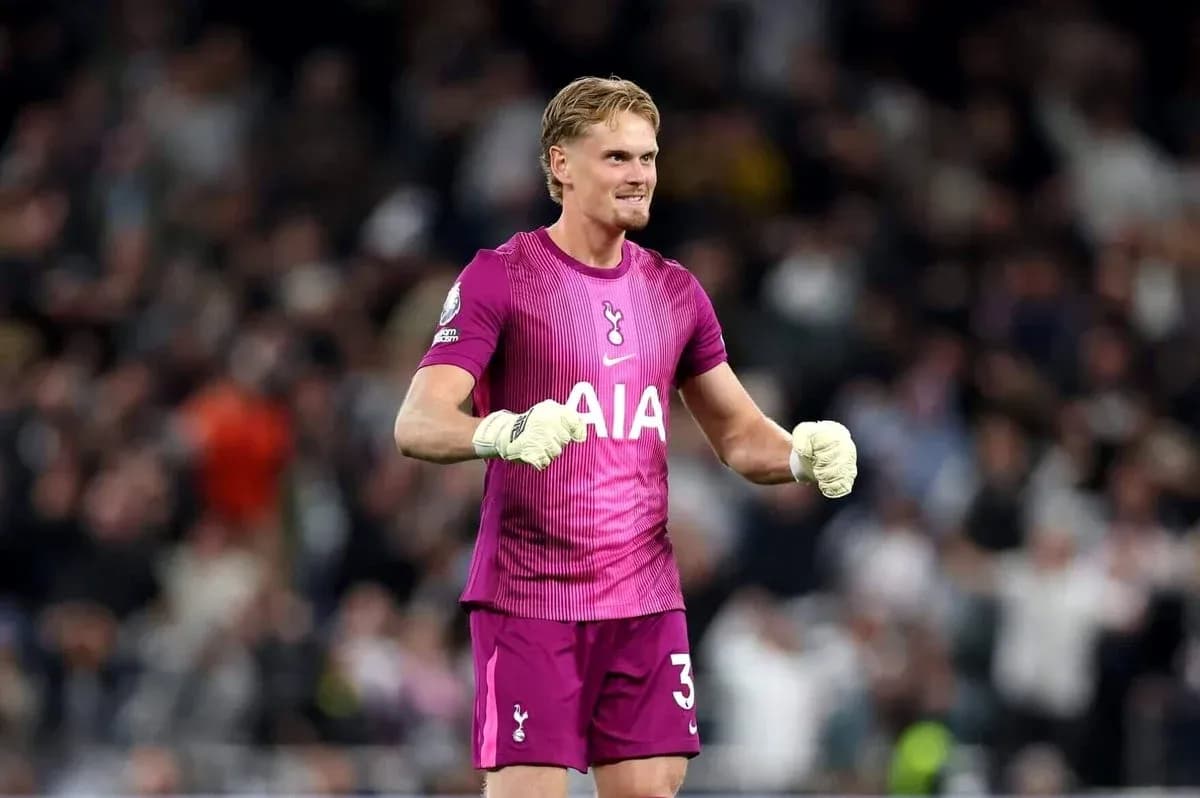
At full time against Leeds, he stood in front of the away end, taking in the applause. A few weeks ago, those same supporters might have watched him through their fingers. Now they see one of their most reliable performers in a relegation fight they never expected to be part of.
Tel’s lesson, Spurs’ reality
The night wasn’t just about Kinsky. Mathys Tel lived both sides of the emotional spectrum in 90 minutes.
His goal, a beautifully curled finish, put Tottenham in front and briefly eased the tension. Then came the moment he will replay in his head: an ill-judged attempt at an overhead kick clearance in his own box, wild and unnecessary, that led directly to Dominic Calvert-Lewin’s equaliser from the penalty spot.
If Kinsky is the model of how to respond to trauma, Tel is at the start of that journey. De Zerbi spoke afterwards of giving the young forward “a big hug and a big kiss”, the sort of public reassurance that hints at how important he believes Tel will be — and how vital it is not to let one mistake warp a career.
Spurs, though, do not have the luxury of lingering on it. They sit just two points ahead of West Ham, who go to Newcastle United on Sunday with survival on the line. Every fixture now carries the weight of consequence.
Kinsky’s redemption arc feels complete. The Madrid nightmare has not been erased, but it has been answered, and answered emphatically. Yet for Tottenham, the story is still being written.
Chelsea and Everton await. The margins will be thin, the pressure suffocating. If there is another chapter to be added to Kinsky’s revival, this is exactly when Spurs will demand it.