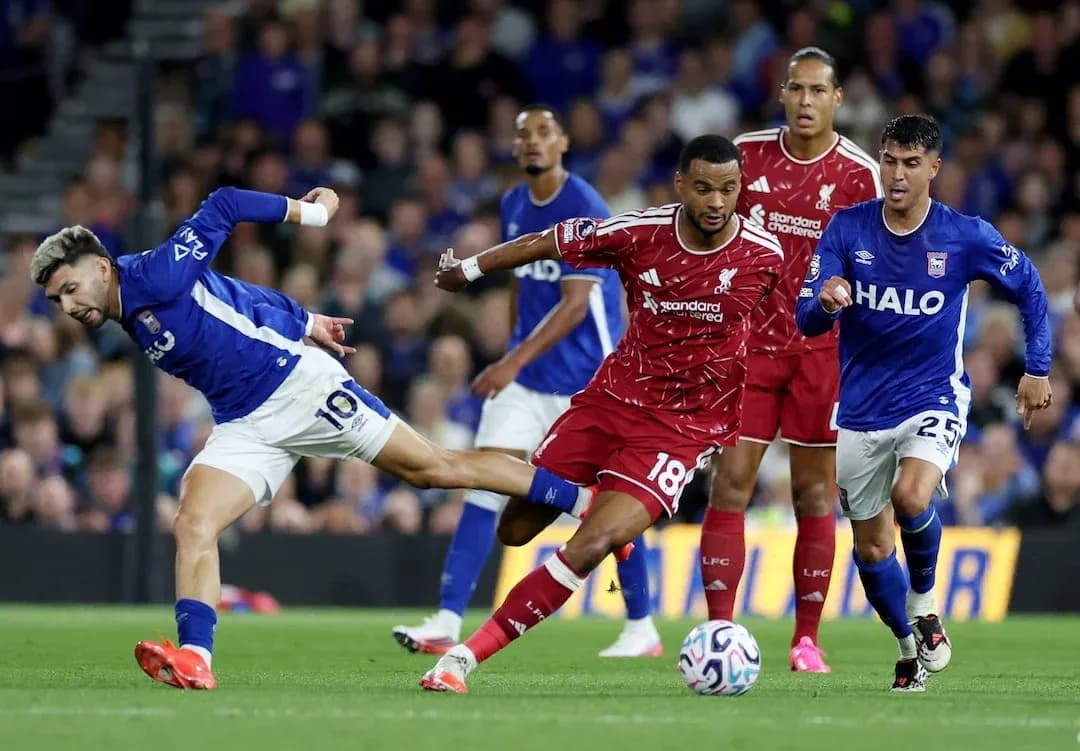
Ipswich vs Liverpool: A Lesson in Premier League Ruthlessness
Portman Road under the Friday night lights has already delivered its verdict: Ipswich 0–2 Liverpool, a lesson in Premier League ruthlessness that also laid bare the structural gap between a newly arrived side and a hardened contender.
I. The Big Picture – contrasting early-season identities
Following this result, Ipswich sit 14th with 3 points from 3 matches. Overall they have scored 4 and conceded 8, giving them a goal difference of -4. At home they have played 2, winning 1 and losing 1, with 2 goals for and 3 against. The pattern is already clear: G. O'Neil’s team are brave in structure but fragile in exposure. Their overall goals for average stands at 1.3, while their overall goals against average is 2.7; at Portman Road specifically, they are scoring 1.0 and conceding 1.5 on average.
Liverpool, by contrast, leave Suffolk in 6th place with 5 points from 3 games. Overall they have scored 6 and conceded 4, for a goal difference of +2. On their travels they have taken 4 points from 2 matches, scoring 4 and conceding 2, with a sharp away goals for average of 2.0 and an away goals against average of 1.0. Andoni Iraola’s side are unbeaten, and their overall scoring rate of 2.0 per game is matched by a relatively tight overall defensive average of 1.3 conceded.
Both coaches set up in a 4-2-3-1, but the systems told different stories. For Ipswich, it was a framework to survive and spring. For Liverpool, it was a platform to suffocate and slice.
II. Tactical Voids – absences and discipline shaping the contest
Ipswich arrived into this fixture shorn of midfield ballast and wide threat. A. Matusiwa and J. Taylor were both missing with injuries, while J. Philogene’s absence stripped O'Neil of one of his most direct outlets. That left S. Lukić and E. Palacios as the double pivot, with J. Enciso and A. Fatawu asked to provide incision between the lines and from wide. The structure remained the same as in their previous league games – they have used 4-2-3-1 in all 3 matches – but the personnel losses meant less bite in midfield duels and fewer natural runners to stretch Liverpool’s back line.
Liverpool’s own absentee list was substantial but better absorbed. C. Bradley, F. Chiesa, H. Ekitike, J. Gomez and G. Leoni were all ruled out, yet Iraola could still field a high-level spine: Alisson Becker behind a back four of R. Araújo, J. Jacquet, V. van Dijk and M. Kerkez, with D. Szoboszlai and A. Mac Allister anchoring midfield. The depth on the bench – including W. Endo, R. Gravenberch, J. Frimpong, B. Barcola and others – underlined the structural advantage.
Disciplinary trends also framed the risk profiles. Heading into this game, Ipswich’s yellow cards were heavily front‑loaded: 75.00% of their cautions arrived between 31–45 minutes, with another 25.00% between 46–60. It is a side that often has to foul as the tempo spikes either side of half-time. Liverpool’s yellows, on the other hand, were distributed more evenly but with a clear spike: 40.00% of their cautions came between 46–60 minutes, and 20.00% each in the 16–30 and 76–90 windows. This is a team that maintains aggression deep into games.
Individually, M. Kerkez epitomises that edge. He already had 2 yellow cards in the league and appears in both the top yellow and top red card lists, a full‑throttle left‑back who had to manage the duel with Fatawu under the referee D. England’s gaze. R. Araújo, with 1 yellow so far, brings similar intensity on the right side of the defence.
III. Key Matchups – hunter vs shield, engine room vs engine room
The headline duel was always going to be Alexander Isak against the Ipswich back line. Isak entered the fixture as the league’s leading scorer with 3 goals from 3 appearances, converting 5 of his 7 shots on target. His movement between the lines and into the channels targeted a defence that, overall, had conceded 8 goals in 3 games and had yet to keep a single clean sheet. Ipswich’s centre‑backs I. Diop and J. Greaves, shielded by Lukić and Palacios, were tasked with containing a forward whose blend of height and mobility is rare.
The “shield” in front of Alisson was Liverpool’s back four plus the double pivot, and they faced an Ipswich attack that, while spirited, is still calibrating. At home Ipswich have managed just 2 goals in 2 matches, and they had already failed to score once overall this season. Emersonn, leading the line, was reliant on service from the trio of D. Maeda, Enciso and Fatawu. Their creativity numbers tell a story: Enciso has 2 assists and 4 key passes overall, with 11 shots and 6 fouls drawn, while Fatawu adds 1 assist, 7 key passes and 15 attempted dribbles. They can hurt teams, but against Liverpool’s structure their margin for error was slim.
In the engine room, the contest between creators and enforcers was fascinating. For Liverpool, C. Gakpo arrived as both top assister in the league (3 assists overall) and a significant goal threat (1 goal, 8 key passes, 4 shots). Operating nominally from the left in the 4-2-3-1, he drifted inside to overload Ipswich’s double pivot. Behind him, Mac Allister and Szoboszlai controlled rhythm and range. Ipswich’s response relied on Lukić’s positional discipline and Palacios’s ability to break lines quickly when possession was won.
On Liverpool’s right, the combination of Wirtz and Víctor Muñoz offered an interior‑heavy threat that dragged Ipswich’s full‑backs into awkward spaces. L. Davis, already tasked with containing underlaps and overlaps, had to judge when to follow Wirtz inside and when to hold the line.
IV. Statistical Prognosis – why Liverpool’s structure was always favoured
From a numbers perspective, Liverpool’s superiority was baked into the matchup. Overall they score 2.0 goals per game and concede 1.3; Ipswich score 1.3 and concede 2.7. On their travels Liverpool are averaging 2.0 scored and 1.0 conceded, while Ipswich at home are at 1.0 for and 1.5 against. Layer onto that Liverpool’s single away clean sheet already this season, compared to Ipswich’s complete lack of clean sheets anywhere, and the probability matrix tilts heavily red.
Discipline and game phases matter too. Liverpool’s yellow‑card spike between 46–60 minutes coincides with a period when Ipswich historically become stretched, having already taken most of their own cautions just before half-time. That mid‑game phase is when Liverpool’s press typically tightens and when players like Gakpo and Isak find space against tiring legs.
Penalty data adds a final layer. Liverpool had taken 1 penalty this season and scored it, with no misses. Ipswich had yet to win a spot‑kick, and with 0 penalties taken there was no safety net in high‑variance moments.
Put together, the tactical reality at Portman Road was almost pre‑written. An Ipswich side still learning Premier League distances, missing key pieces like Matusiwa and Philogene, and carrying a porous overall defensive record, ran into a Liverpool outfit that combines elite individual quality – Isak’s finishing, Gakpo’s creativity, Van Dijk’s leadership – with a robust away profile.
The 2–0 scoreline ultimately felt like the statistical script brought to life: Liverpool’s controlled aggression, superior depth and sharper cutting edge translated their early‑season metrics into three points, while Ipswich were reminded that in this league, structure without protection is an invitation to be punished.