Hapoel Beer Sheva Dominates FK Crvena Zvezda in UEFA Champions League
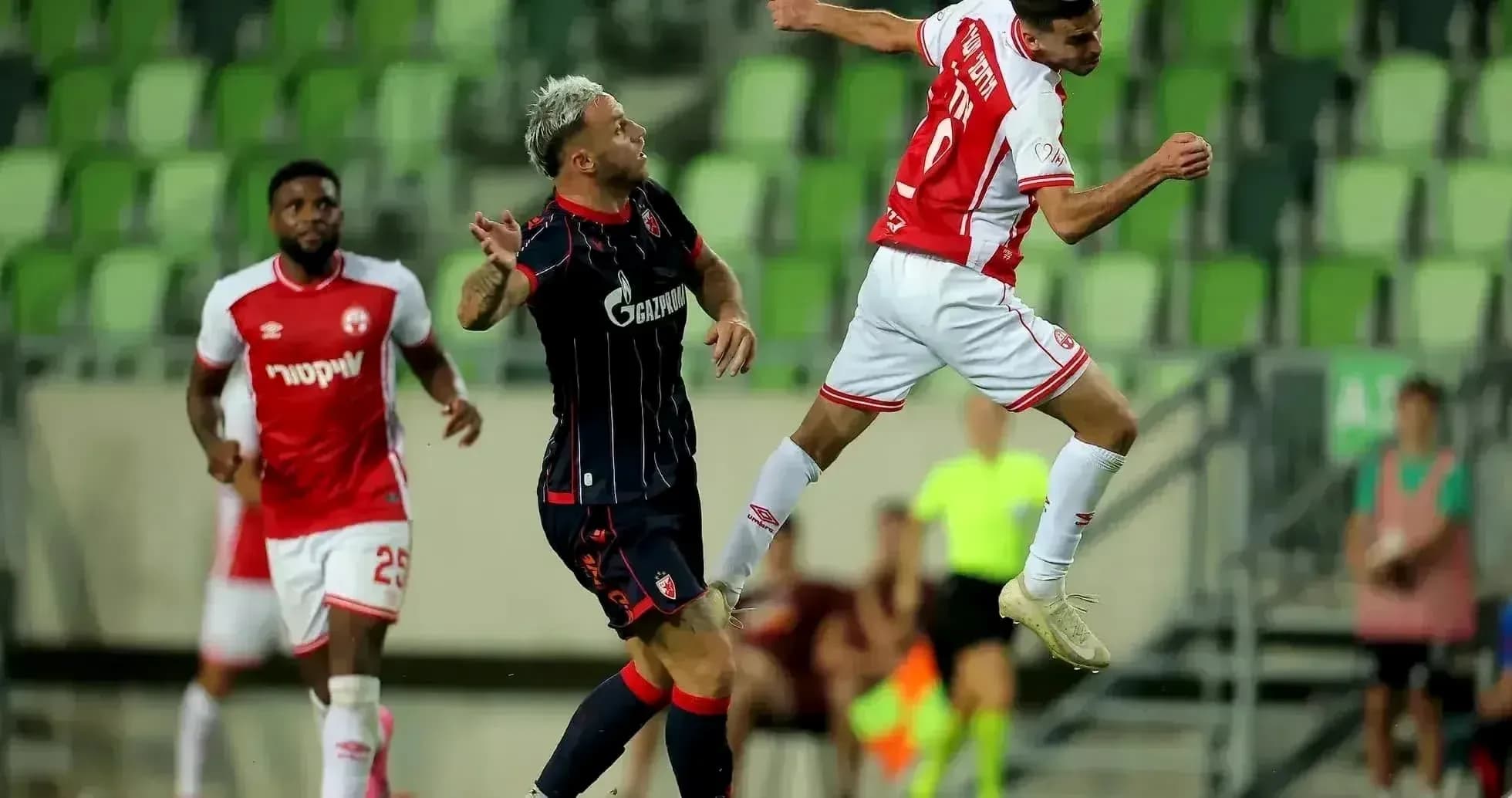
FK Crvena Zvezda’s 0-2 home defeat to Hapoel Beer Sheva at Stadium Rajko Mitić in the UEFA Champions League 3rd Qualifying Round was defined by an extreme territorial imbalance and a collapse in control after going down to ten men, then nine. Hapoel Beer Sheva’s 4-3-3 systematically pinned back Dejan Stankovic’s 4-2-3-1, turning 96% possession into a constant territorial siege. Once the visitors broke through via I. Zlatanovic and then J. East, the hosts lacked both structure and numbers to respond, finishing with two red cards and almost no sustained attacking phases.
Hapoel Beer Sheva built their dominance from the back through a calm 4-3-3 structure. The back four of G. Mizrahi, Miguel Vitor, I. Rotman and P. Amador had the time and space to circulate under minimal pressure, with Lucas Ventura acting as the main pivot in front of them. With 96% of the ball, the visitors could keep their three midfielders staggered: E. Peretz often stepping higher to connect with the front line, Lucas Ventura holding the central lane, and N. Yehoshua offering a left-sided outlet. This triangle consistently outnumbered FK Crvena Zvezda’s double pivot of T. Elsnik and R. Krunic.
Out of possession, FK Crvena Zvezda’s nominal 4-2-3-1 collapsed into a deep 4-4-2 block with Bruno Duarte and J. Enem trying to screen passes into midfield. However, the lack of pressing intensity allowed Hapoel Beer Sheva to progress methodically. With only 4% possession, the hosts were almost exclusively defending in their own half, forced into a reactive stance where full-backs Seol Young-Woo and N. Tiknizyan rarely advanced simultaneously. The double pivot was stretched horizontally by Hapoel’s constant ball circulation, creating interior pockets for I. Zlatanovic to drop into and combine.
The turning point came with the dismissal of D. Stankovic at 57', which stripped FK Crvena Zvezda of leadership from the technical area and coincided with growing tactical disarray. Hapoel Beer Sheva immediately exploited the psychological and structural disruption. At 61', I. Zlatanovic finished a move assisted by J. East, a pattern that reflected the visitors’ ability to find their centre-forward between the lines and then in the box. The goal rewarded their sustained pressure: 6 shots on goal to Crvena Zvezda’s 2, and near-total control of territory.
Chasing the game, Dejan Stankovic had already tried to inject energy at the interval. At 46', M. Arnautovic (IN) came on for J. Enem (OUT), and M. Abu Fani (IN) replaced T. Elsnik (OUT), signalling a desire for more verticality and ball-winning in midfield. Later, at 62', M. Ivanic (IN) came on for V. Kostov (OUT), and at 73' M. Cham (IN) replaced O. Bukari (OUT), while at 80' A. Katai (IN) entered for N. Tiknizyan (OUT). These moves gradually tilted the side into a more attacking, risk-heavy shape, pushing extra creative profiles higher and weakening the defensive platform on the flanks.
However, with such a tiny share of possession, these changes never translated into sustained pressure. FK Crvena Zvezda managed only 3 corner kicks and 2 shots on goal, relying on sporadic counters and isolated transitions rather than structured attacks. The lack of passing data underscores how little time they spent constructing moves; most of their play was second-ball defending and emergency clearances. Hapoel Beer Sheva, by contrast, could rotate their front line without losing control: at 66', H. Kanaan (IN) replaced G. Mizrahi (OUT), and M. Abu Rumi (IN) came on for N. Yehoshua (OUT), refreshing legs in the wide and midfield zones while preserving the 4-3-3 spacing.
The second goal at 79' – J. East finishing from an E. Peretz assist – encapsulated the tactical pattern. With FK Crvena Zvezda stretched and mentally drained, Hapoel Beer Sheva’s high-possession game finally converted positional dominance into a decisive scoreline. East’s constant movement from the right, combined with Peretz’s advanced midfield role, repeatedly overloaded the home side’s left channel, where the full-back and wide midfielder were often isolated.
Discipline further undermined FK Crvena Zvezda’s structure. They committed 10 fouls to Hapoel Beer Sheva’s 5 and collected 1 red card via M. Abu Fani for “Roughing” at 90+2', on top of the earlier red to D. Stankovic. Reduced to nine men by the end, any hope of a late push disappeared. Hapoel Beer Sheva’s own aggression was controlled: two yellow cards, one to I. Rotman for “Holding” at 22' and another to Lucas Ventura for “Roughing” at 63', did not alter their tactical cohesion or their ability to keep the ball.
In the final minutes, Ran Kozuch managed the game pragmatically. At 76', D. T. Diop (IN) replaced I. Zlatanovic (OUT), adding fresh energy up front to press and run channels. At 90+2', O. Davidzada (IN) came on for P. Amador (OUT) and A. Ohana (IN) replaced J. East (OUT), locking in defensive stability and game management on the flanks. With 3 corner kicks and only 1 blocked shot, Hapoel Beer Sheva did not need a barrage of attempts; their control phase was the main defensive mechanism, denying FK Crvena Zvezda any platform to build.
Statistically, the match paints an extreme picture. Hapoel Beer Sheva’s 96% possession is almost unheard of at this level, reflecting not just technical superiority but a complete grip on tempo and territory. Their 6 shots on goal versus 2 for FK Crvena Zvezda, combined with a 2-1 edge in blocked shots (1 for Hapoel, 2 for Zvezda), shows that while the shot volume was not huge, the quality and control of situations heavily favoured the visitors. FK Crvena Zvezda’s inability to generate more than 3 corners or any meaningful passing rhythm meant their 4-2-3-1 never functioned as an attacking system; it was a defensive shell under siege.
Discipline numbers further underline the tactical story: FK Crvena Zvezda finished with 2 red cards and 0 yellows, while Hapoel Beer Sheva had 2 yellows and no dismissals. The home side’s 10 fouls were often last-resort interventions in a game where they were constantly chasing shadows. In contrast, Hapoel Beer Sheva’s 5 fouls were part of a controlled press rather than desperation. In a two-legged European tie context, this match not only gives Hapoel Beer Sheva a commanding 2-0 lead but also exposes deep structural issues for FK Crvena Zvezda in coping with high-possession, positionally disciplined opponents.