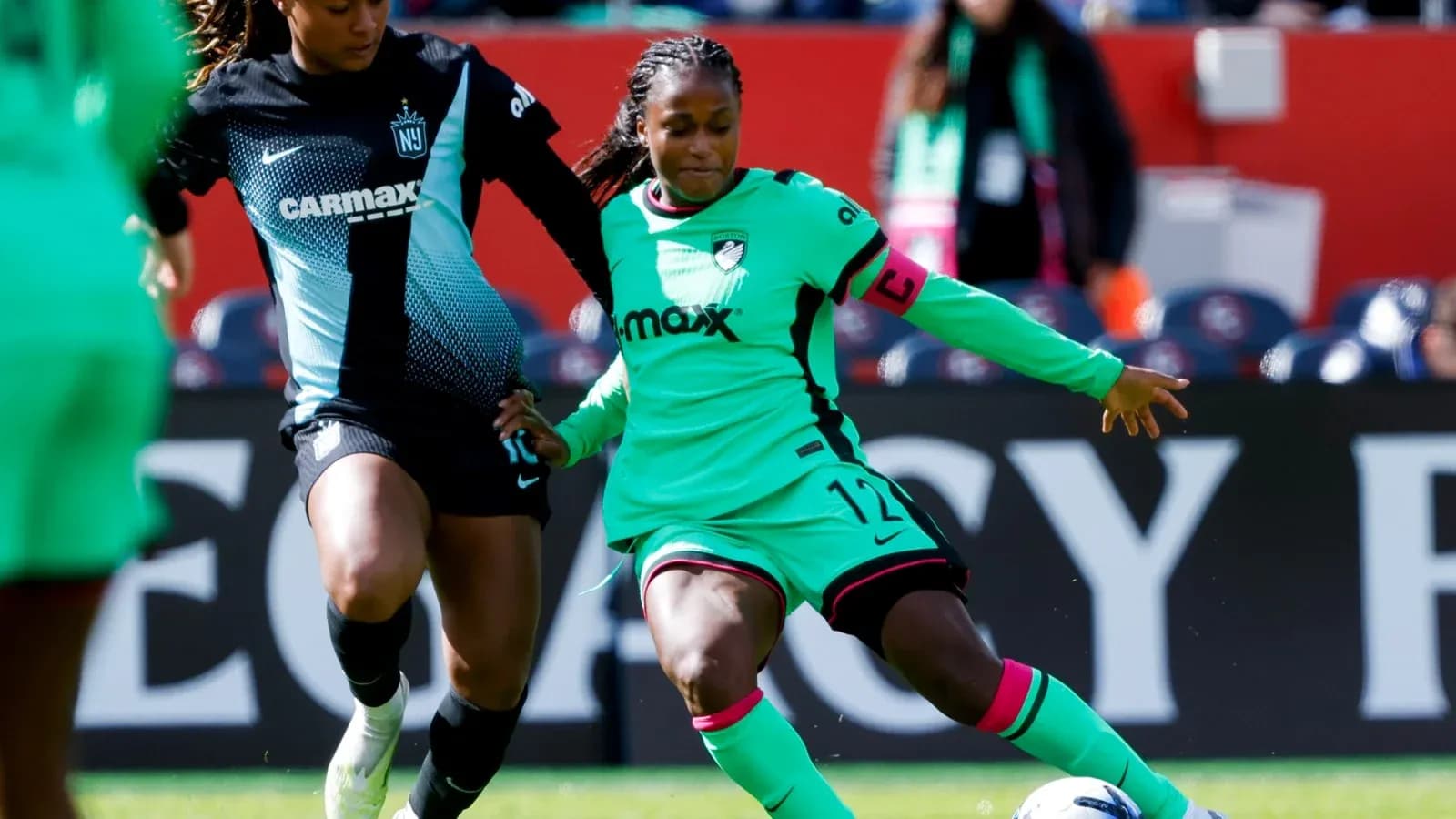
Gotham FC W and Boston Legacy W End in Tactical Draw
NJ/NY Gotham FC W and Boston Legacy W shared a 1-1 draw at Sports Illustrated Stadium, a result that accurately reflects a match of contrasting structures and alternating control. Gotham’s 4-2-3-1 gave them a slight edge in possession and territorial play, while Boston’s 3-1-4-2 carried a sharper vertical threat despite fewer total shots. Both goalkeepers made three saves, and neither side generated overwhelming pressure for long stretches, turning this NWSL group-stage fixture into a tactical arm-wrestle rather than a wide-open contest.
I. Executive Summary
Gotham’s 4-2-3-1, orchestrated by coach Juan Amoros, sought to dominate the ball (53% possession, 295 passes, 80% accuracy) and progress through a technically strong double pivot and an attacking midfield line led by Jaedyn Shaw. Boston’s 3-1-4-2 compacted central zones and looked to spring forwards Barbara Olivieri and Amanda Gutierres quickly, using wingbacks and advanced midfielders to attack space. The first half contained both goals—Shaw for Gotham, Alba Caño for Boston—before the second period settled into a controlled stalemate where structural discipline outweighed risk.
II. Scoring Sequence & Disciplinary Log
Disciplinary log (all cards, in order):
- 21' Barbara Olivieri (Boston Legacy W) — Foul
- 28' Samantha Rose Smith (Boston Legacy W) — Foul
- 45+2' Laís Araújo (Boston Legacy W) — Foul
Card verification step: Gotham received 0 cards; Boston received 3 yellow cards; Total: 3.
The scoring sequence began with Gotham’s structural superiority between the lines. On 37', Jaedyn Shaw struck for NJ/NY Gotham FC W, capitalizing on the platform provided by the 4-2-3-1 and the advanced positioning of the three attacking midfielders. Her goal rewarded Gotham’s ability to pin Boston back and circulate possession until a gap appeared.
Boston reacted quickly. On 40', Alba Caño equalized for Boston Legacy W, assisted by Barbara Olivieri. The move encapsulated Boston’s 3-1-4-2 idea: use the front two and the advanced midfield line to break Gotham’s rest defense with direct, incisive actions. Caño’s timing from midfield and Olivieri’s involvement as a creative forward highlighted how Boston could bypass Gotham’s double pivot when they won the ball in transition.
The first half thus closed at 1-1, matching the half-time scoreline in the data. Boston’s physical edge and willingness to disrupt Gotham’s rhythm were visible in the disciplinary profile: three yellow cards, all for “Foul,” with Olivieri (21'), Samantha Rose Smith (28'), and Laís Araújo (45+2') booked as they tried to slow Gotham’s build-up and protect their defensive line.
The second half’s main structural shifts came via Boston substitutions at 57'. Jorelyn Carabalí (IN) came on for Samantha Rose Smith (OUT), and Aissata Traore (IN) came on for Barbara Olivieri (OUT). Both changes adjusted Boston’s balance between control and direct threat without altering the final 1-1 scoreline.
III. Tactical Breakdown & Personnel
Gotham’s 4-2-3-1 was built on stability at the back and layered progression. Ann-Katrin Berger, with 3 goalkeeper saves, operated as a secure last line rather than an overworked shot-stopper. The back four of Margaret Purce, Jess Carter, Tierna Davidson, and Guro Reiten provided a broad platform: fullbacks Purce and Reiten could step into higher lanes, while Carter and Davidson held a relatively high line, trusting Berger’s positioning behind them.
In midfield, Jaelin Howell and Savannah McCaskill as a double pivot were central to Gotham’s 53% possession and 295 passes (236 accurate, 80%). Howell anchored, screening transitions and recycling possession, while McCaskill linked into the attacking three. Ahead of them, Jordynn Dudley, Sarah Schupansky, and Jaedyn Shaw formed a fluid line of three behind striker Esther González. Shaw’s goal at 37' underlined her role as Gotham’s key final-third problem-solver, attacking the half-spaces and exploiting the pockets around Boston’s single holding midfielder.
Boston’s 3-1-4-2, with Casey Murphy in goal, aimed to compress central channels and then break quickly. Murphy matched Berger with 3 saves, reflecting a broadly even shot quality exchange (Gotham: 3 shots on goal; Boston: 4). The back three of Bianca St Georges, Laís Araújo, and Emerson Elgin protected the box while allowing wing and midfield lines to push higher. Araújo’s yellow card at 45+2'—“Foul”—came as she stepped aggressively into duels to prevent Gotham’s vertical passes.
In front of the back three, Annie Karich operated as the single pivot, with a four-woman band of Nichelle Prince, Alba Caño, Josefine Hasbo, and Samantha Rose Smith across midfield. Caño’s equalizer on 40' captured Boston’s best offensive pattern: a midfield runner arriving from the second line, exploiting the space behind Gotham’s double pivot. Olivieri and Gutierres as the front two provided targets for direct passes and combinations, with Olivieri both drawing a yellow card (for “Foul”) and supplying the assist for Caño’s goal before being replaced by Aissata Traore at 57'.
The 57' substitutions subtly rebalanced Boston. Jorelyn Carabalí (IN) for Samantha Rose Smith (OUT) strengthened the defensive structure, adding another natural defender to protect the back line and guard against Gotham’s wide overloads. Traore (IN) for Olivieri (OUT) kept a vertical outlet up front, but with slightly different movement profiles, aiming more to stretch Gotham’s defense than to drop and create.
IV. The Statistical Verdict
The statistical picture supports the 1-1 outcome. Gotham produced 6 total shots (3 on goal, 2 off, 1 blocked) with 5 attempts inside the box, reflecting their territorial advantage and more sustained pressure phases. Boston, with only 5 total shots (4 on goal, 0 off, 1 blocked), were more selective but efficient, turning limited entries into relatively dangerous efforts.
Possession split 53%–47% in Gotham’s favor, and their 295 passes, 236 accurate (80%), slightly outstripped Boston’s 265 passes, 208 accurate (78%). Gotham’s Overall Form in this match was that of a team comfortable circulating and probing but without overwhelming incision. Boston’s Defensive Index is underlined by their 14 fouls, 3 yellow cards, and willingness to disrupt rhythm, yet they still conceded only 6 shots.
With expected goals data not provided, the balance of shots on target (3 vs 4), equal goalkeeper saves (3 vs 3), and the shared first-half scoring window all point to a contest where structural ideas on both sides largely cancelled each other out. Gotham’s ball dominance met Boston’s compact 3-1-4-2 and direct transitions, and the 1-1 final score reads as a tactically coherent draw rather than a missed opportunity for either side.