France and Spain Face Tactical Showdown in World Cup Semi-Final
France has advanced through the World Cup with impressive attacking flair, their forwards enjoying freedom on the pitch. Yet Didier Deschamps harbors a lingering worry: how will his two-man midfield cope against Spain's three-man setup? Facing a team that dominates possession and crowds the midfield, France could find themselves outnumbered where it matters most.
Spain sticks to its well-defined tactical blueprint, arguably the most complete at this tournament. This structure influences players like Lamine Yamal, whose role is clearly outlined despite intense marking. Many opponents have had to leave games early due to exhaustion from chasing him.
Spanish Strategy and Defensive Strength
Spain’s defensive resilience comes from dropping their possession shape deeper by about 20 meters to avoid exposure against France’s pace upfront. Their ability to regain possession swiftly is unmatched—they recover the ball within 11.57 seconds on average, the fastest among quarter-finalists. The Spanish press relentlessly in forward areas, leaving a significant space behind their defense that French stars like Kylian Mbappe and Ousmane Dembele are eager to exploit.
More Than Defense Versus Attack
Although this match pits the tournament’s best defense against the top attack, it’s far more layered. Spain will maintain higher possession near France’s goal, while Deschamps liberates his attackers from deeper positions. This contrast extends beyond the surface numbers of goals and clean sheets.
This semi-final is also a meeting of neighbors with a rich footballing rivalry. Past comments from Adrien Rabiot about Yamal needing to "do more" have resurfaced, highlighting how these teams have shaped each other over recent years.
Shifts Since Their Last Meeting
Two years ago, Spain appeared freer and fresher, led by young talent, while France struggled offensively. Since then, injuries have limited Spain’s most electric attackers, forcing them into a more compact style sometimes criticized as dull. France, conversely, has welcomed a wave of youthful brilliance, including Michael Olise and Desire Doue, with some veterans now in peak form.
Deschamps has embraced a style unlike his usual pragmatic approach, fostering a team that thrives on creative freedom for its attackers. This sets up a philosophical battle between Spain’s strict positional game, inspired by Pep Guardiola, and France’s more fluid "relationism" approach, where individual expression plays a bigger role.
Philosophical Duel on the Pitch
Spain’s game relies heavily on team structure dictating ball movement, with limited freedom given even to key players like Yamal and Dani Olmo. France’s attackers enjoy much greater latitude to interpret the game, creating a clash reminiscent of orchestra versus free jazz.
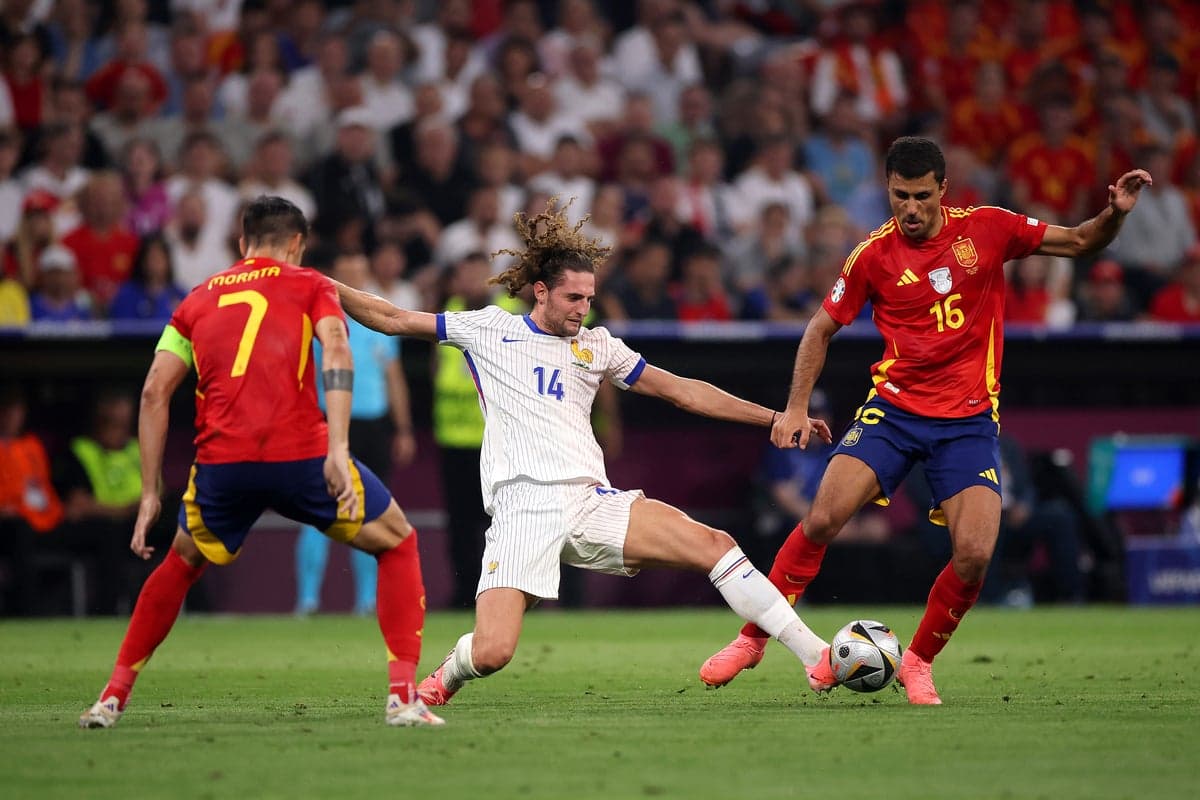
This duel raises questions about future trends in football tactics. Spain’s precise system demands unique player types, like Rodri, a kind of midfielder few other nations produce. France lacks a classic number six, relying instead on the hardworking duo of Rabiot and Aurelien Tchouameni. This puts pressure on France to adapt and do more, despite their attacking success so far.
What to Expect From the Match
The pattern seems clear: Spain will control possession and push up the field gradually, while France looks to strike quickly on breaks. Observers noted vulnerabilities in Spain’s defense during Belgium’s recent attack, suggesting France can exploit that if they apply enough pressure.
Even after conceding a goal that ended Unai Simon’s clean sheet streak, Spain remained composed and continued their style. Against France, they must sustain this resilience to keep their star attackers from dominating possession.
This matchup transcends a simple attack versus defense narrative. It represents a tactical duel with potential lasting impact on football’s evolution.