
England's World Cup Challenge: Balancing Focus and Transfer Distractions
At a World Cup, the story is supposed to be simple. Flag on your chest, anthem in your ears, nothing else in your head.
This summer, for England, it is anything but.
Thomas Tuchel has taken a 26-man squad to the United States with one eye on Croatia in the opener and the other on a transfer market that refuses to pause. The World Cup will last five weeks; the phones will never be off. Sporting directors will call. Agents will text. Offers will land in inboxes between ice baths and team meetings.
Tuchel knows it. His players feel it.
“If I said to the players not to deal with it now, their telephone will still blow up,” he admitted. “I can see the distraction if clubs want to sign you, and sporting directors, agents and coaches are trying to get you on the phone, of course it is a distraction.”
He can recommend early decisions, he says. He cannot control the market.
A World Cup shop window
This is the stage that changes lives. James Rodriguez scorched his way through 2014 and ended up at Real Madrid. Enzo Fernandez did the same in Qatar before Chelsea arrived with a cheque book. Harry Maguire’s 2018 displays helped propel him to Manchester United.
Perform here and your value soars. Perform here and the transfer noise grows louder.
But the same glare can burn. For every player who rides a World Cup wave into a dream move, there are others whose summers are swallowed by speculation and distraction. Tuchel’s challenge is to keep England’s focus on the pitch while the market swirls around them.
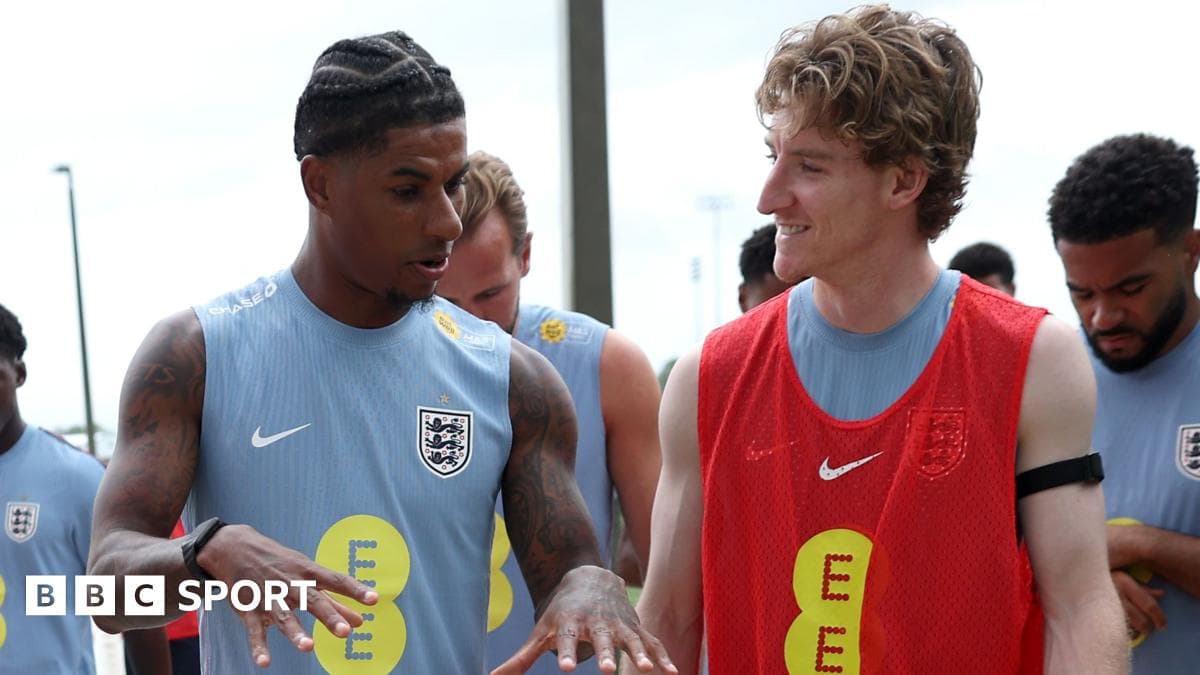
England are working in the heat of West Palm Beach, Florida, trying to harden bodies for the conditions and rhythms of this World Cup. The sessions are intense. The travel demands are heavy. For several players, the uncertainty is heavier still.
Elliot Anderson: England’s £100m question
Elliot Anderson walks that tightrope more than most.
The midfielder earned his place in Tuchel’s squad after a superb season with Nottingham Forest. Now both halves of Manchester are circling. Manchester City have already seen an opening bid turned away by Forest. Manchester United are watching closely. At 23, Anderson is believed to favour a move to Etihad Stadium.
If Forest finally relent, the numbers will be enormous. The potential fee is being talked about in terms that would eclipse the £105m Arsenal paid West Ham for Declan Rice in 2023. A British transfer record, in the middle of a World Cup, hanging over a player asked to dictate England’s tempo.
Every training drill, every media appearance, every minute he plays will be viewed through that lens: is this the summer Anderson becomes the most expensive British footballer in history?
Morgan Rogers: the £80m creator in demand
He is not alone in the shop window. Morgan Rogers has forced his way to the front of it.
The Aston Villa attacking midfielder put together a standout 2025-26 campaign: 55 appearances, 14 goals, 12 assists. Those numbers have not gone unnoticed. Arsenal want him. Manchester United want him. Chelsea and Manchester City have also been linked.
According to BBC Sport’s senior football correspondent Sami Mokbel, any club that wants Rogers will need to start the conversation above £80m. That kind of valuation changes how a player is seen. It can also change how a player sees himself.
Rogers arrives in camp as a key attacking option for Tuchel and, at the same time, a major asset in a summer market that is already overheating.
Gordon done, Rashford waiting
One England forward has clarity. Anthony Gordon tied up his move from Newcastle United to Barcelona before the squad flew across the Atlantic. Deal done, future set, mind clear.
Marcus Rashford does not have that luxury.
The 28-year-old is on loan at Barcelona from Manchester United. The Catalan club hold a clause to make the move permanent for £26m, but there is a deadline: 15 June, just two days before England’s World Cup opener against Croatia. Barcelona have been trying to renegotiate the terms, pushing and probing to tweak the deal.
If they do not trigger the clause in time, Rashford’s future slides into limbo. Negotiations would continue while the tournament is in full swing, with his next club still unresolved as he pulls on an England shirt.
It is precisely the kind of background noise Tuchel is trying to manage.
Stones steps into the unknown
At the other end of his career arc, John Stones arrives with a glittering past and an empty future.
He has closed the book on a decade at Manchester City, a spell that turned him into one of the most decorated English players of his generation: six Premier League titles, a Champions League, two FA Cups, five League Cups among a haul of honours that would fill a museum cabinet.
Now he is out of contract and searching for a new home.
For Tuchel, that status presents a different kind of challenge. Stones has nothing to negotiate, no club to appease, no transfer fee to justify. But he does have a career-defining choice ahead. One more big move. One more project. One more manager to trust.
Tuchel’s line is clear.
“It’s about common sense. I would not like it [transfers] the day before a match, or on a matchday, that’s the policy,” he said. “But everything else if it’s done privately, efficiently and quietly then we are always happy to help.
“It helps to have clarity around the player. The best thing we can have is clarity so if anyone has a chance to complete a change of club and a transfer we will not stand in their way.
“But it has to align, of course, with our schedule and our goals which is to be focused and prepared for matches.”
History of a familiar circus
None of this is new to England.
Major tournaments have long doubled as transfer theatres. In 2006, Ashley Cole spent the World Cup entangled in a protracted exit from Arsenal. The swap deal that eventually took him to Chelsea, with William Gallas going the other way, dragged on so long his medical had to be carried out while he was on England duty in Manchester.
Four years later, Joe Cole went to South Africa without a club after leaving Chelsea. His contract situation was unresolved, his next move unknown. He tried to push it all away.
“I just want to get my head down and try and train and play well. My future will sort itself out. It won’t distract me,” he said before that World Cup.
Players say it. Managers hope it. Agents work around it.
This England squad will try to do the same in the glare of Florida and, soon enough, the World Cup itself. The question is simple and brutal: can Tuchel keep his team’s eyes on the trophy while the rest of the football world keeps trying to buy it, piece by piece?





