
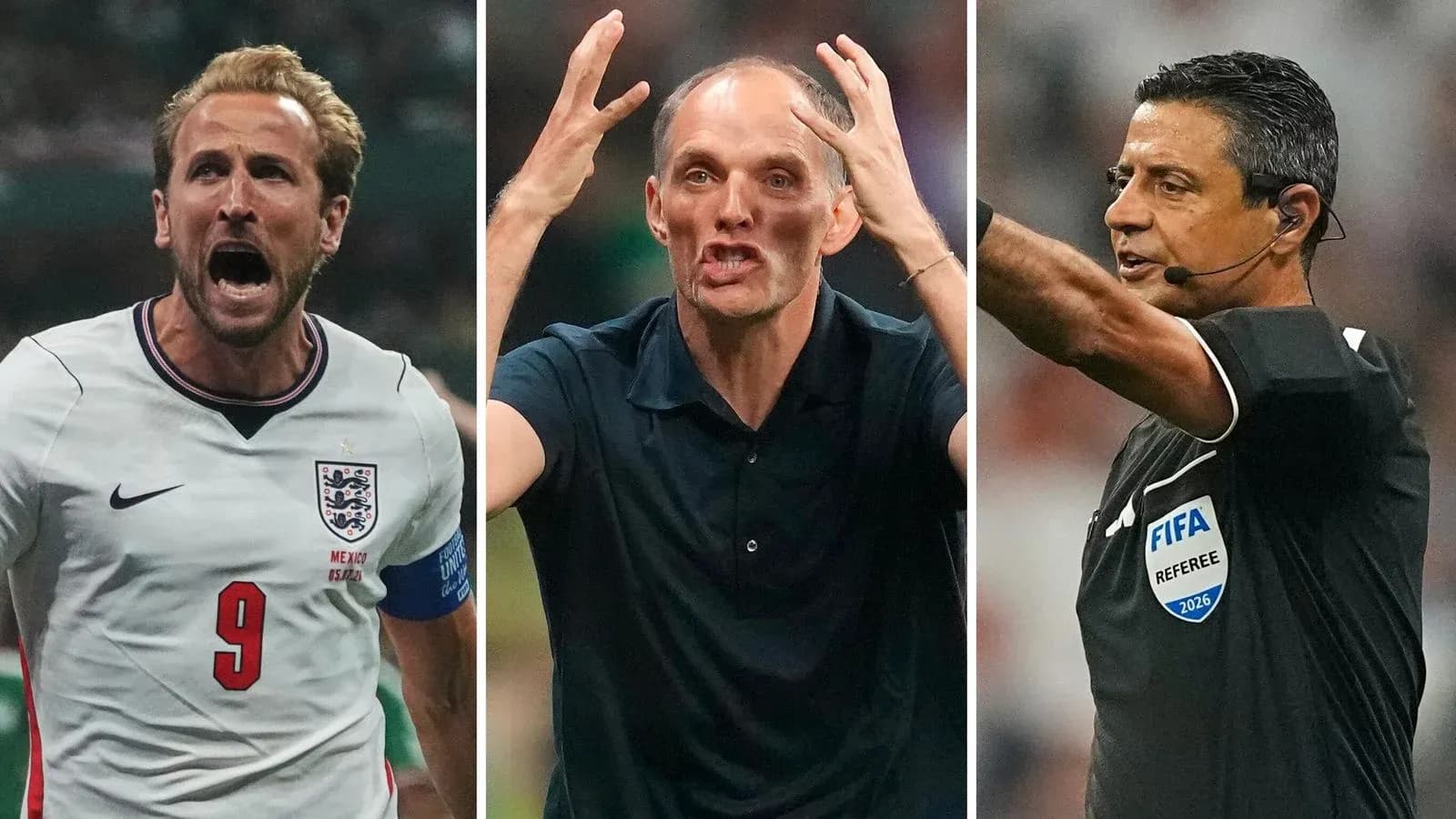
England's Dramatic 3-2 Victory Over Mexico at Azteca
Thomas Tuchel left the Azteca with a place in the World Cup quarter-finals, a battered squad and fury burning at the officials. England left with something else: a statement win that felt like it belonged to the mythology of this stadium.
A 3-2 victory over Mexico, chiselled out with 10 men in the thin air of Mexico City, pushed England into the last eight and into a showdown with Norway. It also pushed their head coach to the edge of his patience.
"It's just not good enough," Tuchel told BBC Sport, his anger aimed squarely at the refereeing team. "Referees are just not good enough. Fourth officials are just not good enough."
On a night of thunder, chaos and stoppage-time agony, his players found a way.
Azteca chaos, England control
The game started an hour late after thunderstorms rolled over the city. The delay only cranked up the noise inside the Azteca. Mexico’s anthem shook the concrete. The atmosphere crackled, but England were the first to strike.
On 36 minutes, Declan Rice drove out from deep, slicing through the first line of pressure and feeding Bukayo Saka. The winger’s cross picked out Jude Bellingham, who timed his run and planted a header home. One chance, one moment of composure, one silenced stadium.
They were not quiet for long.
From the restart, England went for the throat. Just 98 seconds later they were in again, Harry Kane slipping Bellingham through. The finish was scruffy, bundled over the line rather than caressed into the corner, but it did not matter. Bellingham had his second, England had a 2-0 lead, and Mexico were reeling.
The hosts needed something before the break and got it. A soft free-kick, a loose piece of defending, and suddenly the tie was alive again. In the 43rd minute, Julián Quiñones pounced on the second ball and smashed past Jordan Pickford. The Azteca roared back to life.
Pickford then had to claw away a Raul Jimenez header in stoppage time, springing high to his right as Mexico chased a leveller. England reached half-time ahead, but the temperature of the game had changed.
Red card, raw nerves
England started the second half brightly. Anthony Gordon, excellent all night, drove at Mexico’s back line. O’Reilly rattled the right-hand post with a shot from distance on 50 minutes. It felt like a third goal was coming.
Instead, the contest exploded.
In the 54th minute, Jarell Quansah, playing at right-back, launched into a reckless sliding challenge. Referee Alireza Faghani initially let play run, then went to the monitor after a VAR check. The outcome was brutal but inevitable: straight red.
Down to 10 men, in altitude, against a home nation. This was where England’s World Cup could have started to unravel.
Tuchel raged at the decision but had little time to dwell. His team responded the only way they know how: by attacking.
On the hour, they won a penalty. Gordon, again at the heart of it, burst into the box and drew the foul from the goalkeeper. Kane stepped up and buried the spot-kick, restoring a two-goal cushion at 3-1 and briefly easing the tension.
The calm did not last.
Minutes later, Faghani again strode to the monitor. VAR had spotted Kane catching Brian Gutierrez in the area. The referee had not even given a foul on the pitch. This time, he did more than that. He pointed to the spot.
"Is this a clear and obvious mistake for the [Mexico] penalty? For sure not, but VAR gets involved," Tuchel said. "They overturn a situation where he doesn't even give a foul. Not good enough."
Jimenez beat Pickford from 12 yards to make it 3-2 with 20 minutes plus stoppage time still to play. The Azteca sensed a famous comeback. England sensed a siege.
Tuchel’s mentality monster
With the game tilting, Tuchel moved to protect what he had. On 74 minutes, he switched to a back five, sending on Dan Burn and Djed Spence to help see it out. From there, England’s football turned from expressive to defiant.
This is where Tuchel’s description of his side as a "mentality monster" rang true. Level with Croatia, behind to DR Congo earlier in the tournament, now clinging on with 10 men in Mexico City, they refused to fold.
Burn, on his first minutes at a major tournament, hurled himself at crosses and clearances. Pickford came for everything, punching, claiming, bellowing. John Stones almost undid it all deep into stoppage time, skewing the ball inches past his own post in the 100th minute.
Still they held.
Faghani added 11 minutes of stoppage time, then seemed to stretch it further with extra corners. Tuchel could hardly believe it.
"Even in the end it was 11 minutes and he gives another two corners to make it 12 minutes," he said. "Everything went against us."
Yet when the whistle finally went, his anger at the officiating was washed through with something else: pride.
"These are the moments in tournaments where you find a way to win," he said. "This doesn't feel like a round-of-16 match, it feels like a final! The moment where the referee puts the whistle to his mouth, with 10 men, altitude against a home country... this is a moment of joy and a heroic performance and result."
He was right about the scale of it. This was an iconic match in an iconic stadium, the kind that lingers in a nation’s memory long after the tournament moves on.
Heroic night, painful cost
The victory came at a price. Quansah’s red card rules him out of the quarter-final against Norway. He will be available again only if England reach the semi-finals.
More worrying was the sight of Jordan Henderson being carried off at the end, needing oxygen after tumbling over the advertising boards in the celebrations and injuring his wrist.
"Not good. Jordan fell over and injured his wrist. It looks really bad," Tuchel said. The FA confirmed Henderson would stay in Mexico City with a member of the medical staff rather than travel back to Kansas City with the squad. For a coach already emotionally drained, it was a jarring note.
"It's a very special night. Mixed feelings because I'm exhausted and emotional, and sad because Jordan injured his wrist and is in hospital," Tuchel added. "It doesn't fit the evening that Jordan is not with us."
Yet even that could not completely cloud what this meant.
Tuchel admitted there remains a "disconnect" in England’s performances, that they can play better. He knows, though, that he has something every contender craves: a team that refuses to lose.
They have Bellingham and Kane, capable of deciding any game at any level. They have Gordon, delivering his best England performance when it mattered most. They have a defence that, when the storm hits, can bend without breaking.
Most of all, they have a growing belief that whatever the venue, whatever the officiating, whatever the adversity, they will find a way.
Next comes Norway on Saturday, Erling Haaland waiting after dumping Brazil out of the tournament. Another giant, another test of nerve and stamina.
How will England be beaten? Right now, that is the question the rest of the World Cup is starting to ask.





