Dinamo Zagreb vs Viking: Tactical Analysis of 2-2 UEFA Champions League Draw
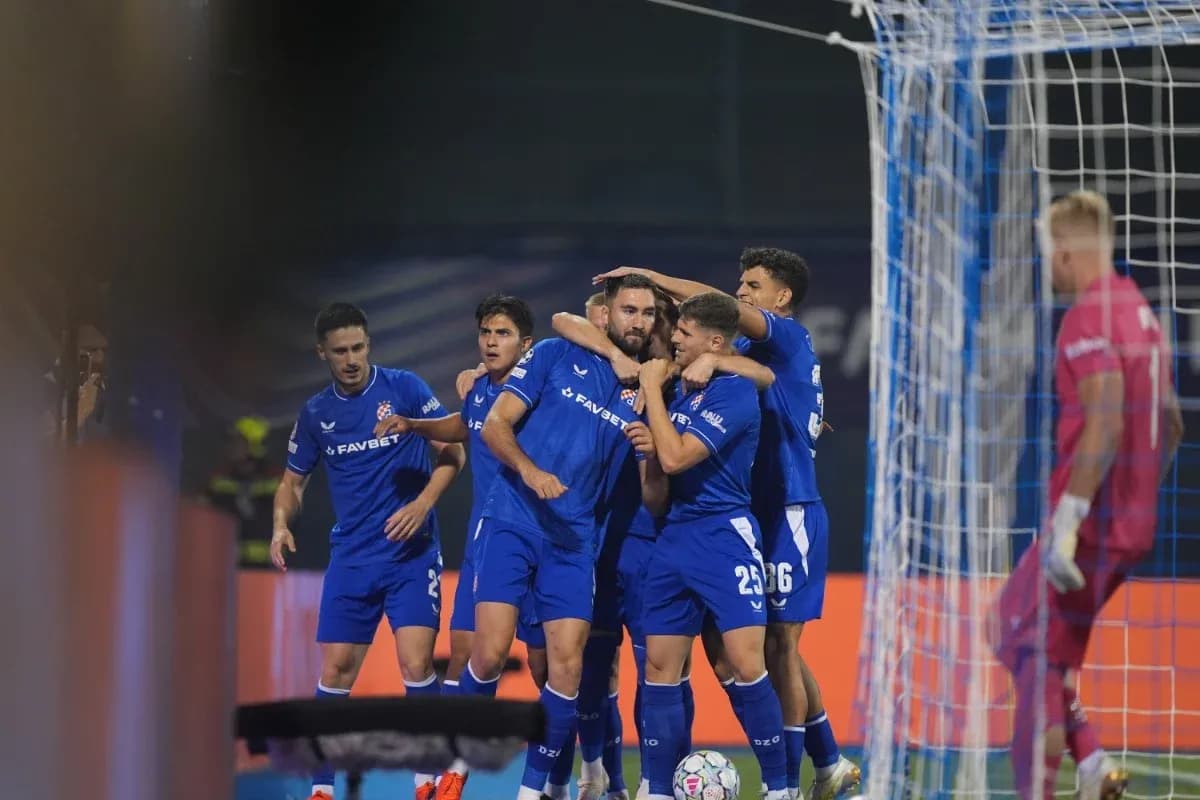
Dinamo Zagreb and Viking produced a tactically rich 2-2 draw at Stadion Maksimir in this UEFA Champions League Play-offs tie, a match defined by Dinamo’s structural dominance against Viking’s ruthless efficiency in transition. Dinamo built a 2-0 lead inside ten minutes but were reeled back to 2-2 by the 39th minute, and despite sustained second-half pressure, they could not translate territorial control into a decisive third goal.
First Half
Dinamo set up in a 4-1-4-1 under Mario Kovacevic, with J. Misic anchoring in front of the back four and a fluid band of four behind lone striker D. Beljo. The structure was clearly designed for high possession and occupation of the half-spaces: M. Lisica and L. Stojkovic worked as advanced interiors, while M. Orsic and M. Zajc provided width and creative support. The plan worked in terms of field control—Dinamo finished with 60% possession and a 544–371 advantage in total passes, completing 438 passes at 81%—but their final-third execution was inconsistent.
The early 2-0 lead illustrated the blueprint. Dinamo repeatedly created overloads on the left, where full-back M. Perez Vinlof advanced aggressively. His assist for Beljo’s opener at 6' came from this pattern: Dinamo circulating patiently, then punching the ball into the channel for a cut-back. Four minutes later, the roles inverted as Beljo linked play and released Lisica for 2-0, demonstrating how the 4-1-4-1 allowed the nominal “8s” to arrive late into the box. At that point, Dinamo’s 17 shots inside the box across the match were already being foreshadowed; they consistently managed to play through Viking’s first line.
However, the same aggressive positioning of Dinamo’s full-backs and advanced interiors exposed them to counter-attacks. Viking’s 4-3-3 under Bjarte Aarsheim was compact and relatively low in possession (40%), but extremely direct once the ball was recovered. With only 6 total shots, 5 of them inside the box, Viking were selective but dangerous. The key was the vertical connection from the midfield three—particularly T. Moi and Joe Bell—into the front line of Z. Tripic and P. Christiansen.
Viking’s first goal at 26' came from precisely this pattern: Moi finding Christiansen with a forward pass or cross after bypassing Dinamo’s midfield shield. The second, on 39', again had Moi as provider, this time for Tripic, underlining how Viking targeted the space behind Dinamo’s advanced full-backs. Dinamo’s back four—M. Valincic, S. Dominguez, S. McKenna, and M. Perez Vinlof—were often defending wide open spaces with little cover, and the 2-2 scoreline at half-time reflected that structural risk.
Goalkeeping Performance
In goal, I. Nevistic (Dinamo Zagreb) had a relatively quiet but costly evening statistically, making 1 save. Given Viking’s 3 shots on goal and 2 goals scored, Viking converted a very high proportion of their on-target attempts. At the other end, A. Ostbo (Viking) made 2 saves against 4 shots on goal, benefiting from the fact that many of Dinamo’s 23 total shots were either off target (12) or blocked (7) by the defensive line before reaching him. This highlights that Viking’s first layer of protection was the compactness and timing of their back four and midfield, rather than heroic goalkeeping.
Second Half
The second half turned into a sustained siege from Dinamo. Kovacevic’s substitutions were clearly aimed at adding freshness and creativity between the lines: L. Kacavenda (IN) came on for M. Zajc (OUT) at 60', followed by R. Mudrazija (IN) for L. Stojkovic (OUT) and A. Hoxha (IN) for M. Lisica (OUT) in the 68th minute. Later, N. Galesic (IN) replaced M. Valincic (OUT) and S. Prevljak (IN) came on for M. Orsic (OUT) at 84', turning the structure into something closer to a 4-2-3-1/4-4-2 hybrid with extra presence in the box.
These changes increased Dinamo’s crossing volume and central occupation but did not fundamentally alter the shot quality problem. The 17 shots inside the box show territory and presence, yet the final actions were rushed or well-blocked. Viking, in response, used their bench to maintain defensive energy and counter threat: S. Kvia-Egeskog (IN) for T. Moi (OUT) at 58' slightly reduced their creative edge but added legs in midfield; S. Bjorshol (IN) for H. Heggheim (OUT) and H. J. Haugen (IN) for K. Haugen (OUT) at 72' refreshed the full-back positions; J. Hansen (IN) for Tripic (OUT) and R. Postema (IN) for Christiansen (OUT) at 87' were late-game moves to protect the draw and still have an outlet.
Discipline and Tactical Role
Discipline also played a subtle tactical role. Viking’s Joe Bell received a yellow card for “Foul” at 65', which may have tempered his aggression in central duels. Dinamo’s Moris Valinčić was booked for “Foul” at 83', just before being substituted, an indication that Viking’s counters were still stretching the home full-backs even late on.
Statistical Overview
Statistically, Dinamo’s dominance is clear: 23 total shots to Viking’s 6, 9 corner kicks to 3, and a significant edge in passing volume and accuracy. Yet the shot-on-goal count (4–3) remained relatively close, underlining that Viking’s low-volume attack produced nearly as many clear looks as Dinamo’s high-volume approach. With expected goals and goals prevented data absent, the raw shot profile already suggests a story of Dinamo volume versus Viking precision.
Tactical Assessment
In tactical terms, Dinamo Zagreb can view this 2-2 as a missed opportunity born from imbalance: their 4-1-4-1 gave them control and chance creation zones but left them fragile against direct transitions. Viking, by contrast, executed their 4-3-3 game plan with discipline—compact without the ball, vertical and incisive with it—maximizing limited possession and turning a difficult away leg into a platform for the tie.