Denver Summit W Dominates Houston Dash W 4-1 at Shell Energy Stadium
Houston Dash W’s 1-4 home defeat to Denver Summit W at Shell Energy Stadium unfolded as a structurally revealing contest. Over 90 minutes, Denver’s 4-2-3-1 repeatedly exposed the Dash’s 4-4-2 in transition and between the lines, turning a 2-1 half-time lead into a commanding four-goal performance. Despite Houston’s share of the ball (47% possession) and a comparable passing volume, Denver’s superior verticality, occupation of the half-spaces and penalty area presence underpinned a clear tactical superiority.
I. Executive Summary
Denver Summit W leveraged a compact mid-block and incisive attacking trident to dominate the key zones. Houston’s double pivot and back four were consistently overloaded by Denver’s line of three (Yazmeen Ryan, Natasha Flint, Natalie Means) behind Klara Melissa Kössler, and the Dash never truly solved the distances between their midfield and defensive lines. Denver’s 14 total shots to Houston’s 7, and 9 shots inside the box to Houston’s 3, mirror a game in which Summit repeatedly reached optimal finishing positions, while the Dash attack remained sporadic and heavily reliant on moments rather than structure.
II. Scoring Sequence & Disciplinary Log
The first major pattern emerged with Denver’s opener on 15'. A long build-up through the right side culminated in J. Sonis attacking the space beyond Houston’s back line, finishing a move assisted by Y. Ryan. The goal highlighted an early issue: Houston’s full-backs, especially on the left, were stretched high, leaving the centre-backs exposed to direct runs.
On 34', Denver doubled their lead via N. Flint. Again, the visitors exploited Houston’s transitional rest defence. With the Dash’s wide midfielders caught ahead of the ball, Denver progressed through the interior lanes, allowing Flint to arrive in a dangerous central pocket and convert without an assist. At this stage, Denver’s 4-2-3-1 looked fluid, with Means and Ryan rotating into half-spaces that Houston’s flat midfield four struggled to track.
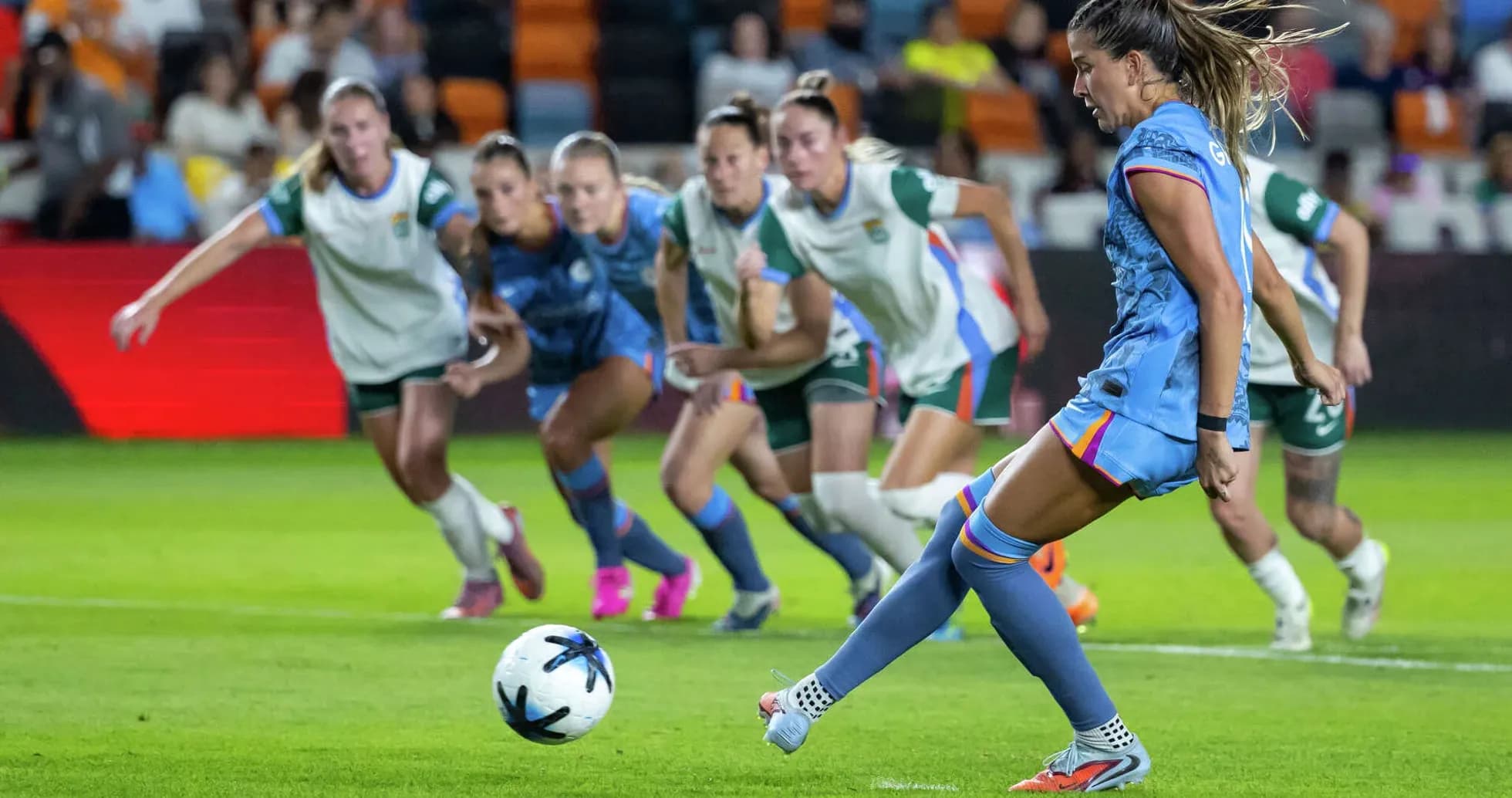
Houston’s lifeline came on 45' from the penalty spot, converted by M. Graham. The Dash’s front pairing of Kate Faasse and Clarissa Larisey had begun to press higher, forcing errors and eventually drawing the decisive incident in the box. Graham’s calm finish brought the score to 1-2 at half-time, but did not fundamentally change the structural dynamics.
After the interval, Houston attempted a corrective move: at 46', C. Larisey (OUT) made way for C. Hardin (IN). This suggested a desire for more defensive stability or fresh legs in the front line. However, Denver quickly reasserted control. On 49', D. Sheehan finished another well-constructed attack, assisted by A. Oke, to make it 1-3. The pattern was familiar: Denver’s full-backs, particularly Oke on the right, advanced to create wide overloads, drawing out Houston’s wide midfielders and opening central channels for late midfield runs.
Discipline then began to reflect Houston’s growing frustration.
- 51' Danielle Colaprico (Houston Dash W) — Foul
Colaprico’s yellow card for “Foul” underlined how often Houston’s midfield was arriving late into duels as Denver circulated quickly through Sheehan and Devin Lynch.
Denver adjusted their own structure on 59', with A. Oke (OUT) replaced by Yuna McCormack (IN), and at 60' N. Means (OUT) for C. Pickett (IN), signalling a tilt toward fresh legs and possibly a more conservative wide presence to protect the lead. Houston responded at 62', swapping D. Colaprico (OUT) for S. Puntigam (IN), likely seeking more positional discipline and ball circulation from deeper midfield.
The decisive tactical blow came on 72', when J. Sonis struck again, assisted once more by Y. Ryan, to push the score to 1-4. Denver’s capacity to repeatedly access the channels between Houston’s centre-backs and full-backs was evident; Sonis’s movement off the last line and Ryan’s timing in the final pass were central themes.
Houston’s second booking arrived as the game slipped away:
- 74' Linda Ullmark (Houston Dash W) — Foul
Ullmark’s yellow card for “Foul” encapsulated the Dash’s reactive defending, often forced into late challenges as Denver circulated the ball with composure.
The final phase was substitution-heavy. Houston tried to refresh both flanks and central spaces:
- 78' L. Klenke (OUT) was replaced by L. Boattin (IN), and L. Ullmark (OUT) by E. Ekic (IN), indicating a push for more progressive passing and attacking quality from full-back and midfield.
- 84' K. Faasse (OUT) came off for M. Bright (IN), adding physical presence up front.
Denver, comfortably ahead, managed minutes and structure:
- 82' M. Kossler (OUT) for O. Thomas (IN) provided fresh energy in the forward line.
- 90' N. Flint (OUT) was replaced by E. Regan (IN), further consolidating midfield control.
Card Totals (locked):
- Houston Dash W: 2 yellow cards
- Denver Summit W: 0 cards
- Total: 2 cards
III. Tactical Breakdown & Personnel
Houston Dash W set up in a 4-4-2 under Fabrice Gautrat, with Jane Campbell in goal behind a back four of Avery Patterson, Paige Nielsen, Malia Berkely and Leah Klenke. The midfield quartet of Katherine Ann Rader, Danielle Colaprico, Maggie Graham and Linda Ullmark supported the front two, Kate Faasse and Clarissa Larisey.
The Dash’s primary issue was vertical compactness. Their front two pressed Denver’s first line but were often disconnected from the midfield four, leaving pockets for Sheehan and Lynch to receive between the lines. When Houston’s wide midfielders jumped to Denver’s full-backs, the half-spaces opened for Ryan and Flint to receive on the turn, driving at Nielsen and Berkely. This structural gap was visible in all three open-play goals conceded.
In possession, Houston’s 382 passes, 295 accurate (77%), show a moderate level of ball retention but limited penetration. With only 3 shots on goal from 7 total shots, the Dash lacked consistent final-third access. Their 7 offsides suggest an attempt to stretch Denver’s line with direct balls into Faasse and Larisey, but the timing and coordination were off, often leading to broken attacks and quick Denver restarts.
Defensively, Jane Campbell registered 2 saves, the same as Abby Smith at the other end, but Denver’s shot profile was far more dangerous. Houston’s back line was repeatedly forced into emergency defending, and while the foul count (5) was low, the two bookings for “Foul” highlight late challenges rather than controlled aggression.
Denver Summit W’s 4-2-3-1 was balanced and purposeful. Abby Smith anchored a back four of Ayo Oke, Eva Gaetino, Kaleigh Kurtz and Janine Sonis. The double pivot of Delanie Sheehan and Devin Lynch provided both screening and progression, while the attacking line of Yazmeen Ryan, Natasha Flint and Natalie Means behind Klara Melissa Kössler consistently manipulated Houston’s defensive shape.
Denver’s 424 passes, 349 accurate (82%), combined with 53% possession, reflect a side comfortable circulating the ball and choosing moments to accelerate. Their 14 total shots, with 7 on target and 9 inside the box, underline a clear strategic focus: use full-back width and No. 10/winger rotations to access central finishing zones. Ryan’s two assists to Sonis and Sheehan’s goal from midfield runs are direct products of this design.
Substitutions for Denver were largely about energy and game-state management rather than structural change. The introduction of Yuna McCormack and Carson Pickett shored up wide areas, while O. Thomas and E. Regan ensured Denver could maintain pressure and possession without sacrificing defensive stability.
IV. The Statistical Verdict
From a statistical and tactical standpoint, Denver Summit W’s 4-1 win was fully aligned with the underlying metrics. Their higher shot volume, superior shot locations, and more efficient passing network translated directly into scoreboard dominance. Houston’s 47% possession and 382 passes, 295 accurate (77%), did not translate into territorial control or chance creation, as evidenced by just 7 shots and 3 on target.
Denver’s 424 passes, 349 accurate (82%), underpinned their ability to stretch and then puncture Houston’s block. The visitors committed more fouls (11 to Houston’s 5), a typical profile of a proactive pressing side willing to disrupt transitions, but crucially they avoided any cards, maintaining defensive availability and rhythm.
Goalkeeper saves being level at 2-2 emphasizes that the difference lay less in shot-stopping and more in chance volume and quality. Houston’s defensive index for this match was poor: too many central entries allowed, inadequate protection for the back four, and insufficient control of Denver’s attacking midfielders. In contrast, Denver’s overall form in this fixture — structurally compact, vertically incisive, and tactically adaptable — fully justified the 1-4 scoreline at Shell Energy Stadium.