Brazil’s World Cup Collapse: Ancelotti's Choices and Neymar's Impact
Brazil did not just go out of this World Cup. They unravelled, slowly and painfully, under the weight of old loyalties and thin ideas.
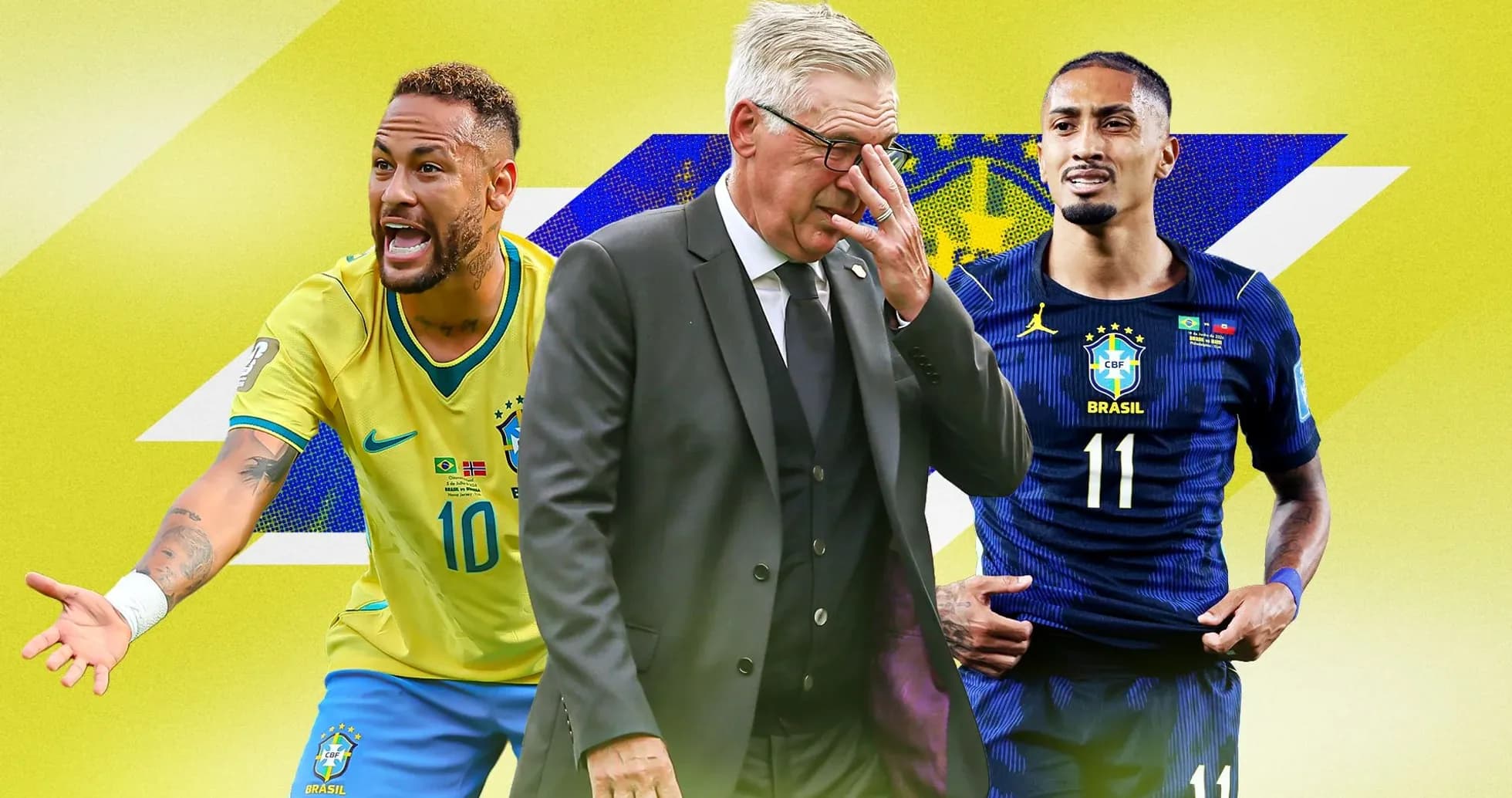
Carlo Ancelotti arrived as the grown-up in the room, the serial winner brought in to restore order to a drifting giant. He leaves this tournament instead as the central figure in a national inquest, his squad choices and in-game calls dissected with the same forensic intensity usually reserved for finals, not failures.
An ageing spine creaks
The warning signs were there in the squad list.
Brazil turned up with three goalkeepers aged 33, 32 and 38. The defence? An average age of 31, anchored by Danilo and Alex Sandro – full-backs who once set the standard in Europe, now looking like echoes from another era.
In midfield, the pattern repeated. Casemiro, 34, again shouldered the burden as the anchor, with 32-year-old Fabinho also heavily involved. Both have been elite operators, both still know the angles and the dark arts. But tournaments are unforgiving when legs go and the game speeds up around you.
There were glimmers of tomorrow. Bournemouth’s 19-year-old Rayan, and Danilo of Botafogo at 25, offered hints of renewal. They felt like cameos in a story that still belonged to yesterday’s men.
Ancelotti did not hide from that reality after the exit. He spoke of the need for “young talent” and “high-level players” to come into Brazilian football, while insisting the current group remained “very solid”. The message was clear: the present is fine, but the future must be different.
The problem is that the present was not fine at all.
Neymar: a recall that backfired
No decision defined this campaign quite like Neymar’s.
At 34, with his last cap in October 2023 and a trail of fitness issues behind him, his recall felt more like a political act than a footballing one. Media pressure. Public nostalgia. The record goal-scorer, the face of a generation. Ancelotti bent.
Brazil paid.
On the eve of the World Cup, Neymar suffered a calf injury that ruled him out for “two to three weeks”. He missed the first two group games, then scraped together just 14 minutes against Scotland in matchday three. That cameo in Miami had the mood of a testimonial, not a nation’s saviour returning to the stage.
Ancelotti’s trust evaporated quickly. Neymar did not feature at all in the dramatic last-32 win over Japan. Against Norway in the round of 16, with Brazil chasing the game, he was sent on for a longer spell but never truly influenced the contest. A late consolation penalty padded the stat sheet but not the performance. If this was his international farewell, it came not with fireworks but with a whimper.
The choice to drag Neymar back into the fold looks even more costly when set against the name left out.
The Joao Pedro question
Joao Pedro’s absence has become the symbol of this failure.
The Chelsea forward, 24, was cut brutally from the final squad despite a superb debut season at Stamford Bridge, delivering 29 combined goals and assists. He was not just in contention; he was widely assumed to be on the plane, perhaps even leading the line as Brazil’s No.9.
His versatility, his form, his momentum – all of it screamed tournament-ready. Ancelotti even conceded, when announcing the squad, that Joao Pedro “probably deserved to be on this list.”
He wasn’t. Neymar was.
When Neymar broke down again and barely played, that call went from debatable to indefensible. Brazil stumbled through the tournament without a fully trusted, in-form central striker who could change the texture of games.
Ronaldo Nazario did not bother with diplomacy in the aftermath. He argued that the elimination “begins with the decisions from the bench” and questioned why Joao Pedro, in form and offering “something different”, was nowhere near the squad. From a man who defined the No.9 shirt, the criticism landed with extra force.
It will not be the last time that decision is replayed.
Midfield left to carry the weight
If the squad’s age profile was one problem, the midfield composition was another.
Ancelotti went into the tournament with just five central midfielders. One of them, Lucas Paqueta, is essentially a No.10. Another, Ederson, only arrived late, called up to replace injured right-back Wesley. The structure was brittle from the start.
Into that vacuum stepped Bruno Guimaraes. The Newcastle captain was asked to be creator, controller, and workhorse all at once. He responded with four assists and long stretches of high-class play, but the imbalance around him was stark.
Ederson and Danilo were given only token minutes from the bench. The trust simply wasn’t there. Brazil’s midfield became Guimaraes plus whoever could still run.
After the loss to Norway, Ancelotti himself pointed at the centre of the pitch as a clear area for change, admitting Brazil “have to move some players” in midfield. It was an honest assessment, if a belated one.
Data, pressure and a decisive penalty
One moment will haunt this campaign more than most: the first-half penalty against Norway.
With the scores level, Brazil had a golden chance to seize control. Many expected Vinicius, their outstanding attacker at the tournament and leading scorer, to step up. Instead, it was Guimaraes who took the responsibility – and saw his effort saved.
Brazil later fell behind and never clawed their way back. The missed penalty became the turning point.
Ancelotti later explained that the choice was data-driven. Internal statistics had Raphinha as the first-choice taker, then Neymar – neither on the pitch at the time – followed by Guimaraes. After him came Gabriel Martinelli.
On paper, it made sense. On grass, in the heat of a knockout tie, it looked cold and detached. The numbers backed Guimaraes. The moment demanded Vinicius. Brazil went with the spreadsheet, not the feel of the game, and paid the price.
Injuries and mitigation – but no escape
Ancelotti is not wrong when he points to injuries. They were brutal and relentless.
Before the squad was even named, Brazil lost Eder Militao, Rodrygo and Estevao Willian. That stripped them of their starting right-back and two wing options who could have been starters or game-changing substitutes.
Once the tournament began, the attrition continued. Neymar’s calf, as predictable as it was damaging, was only the start. Raphinha pulled up in the first half against Haiti in the second group game and did not play again. Paqueta, so often the creative bridge between midfield and attack, limped out at half-time in the knockout win over Japan and was also lost.
By the time Norway arrived in the round of 16, Brazil were patched together. Depth had become a theory, not a reality.
These are valid mitigating factors. They do not erase the missteps that could have been avoided: the ageing core, the thin midfield, the reliance on players whose best days are behind them, the omission of an in-form striker, the faith in data over instinct at a critical moment.
A giant at a crossroads
Ancelotti framed this defeat as “the beginning of a new adventure,” the start of a new cycle rather than the end of an era. He spoke of fresh impetus, new ideas, better assessment of players. He insisted the work done so far has been good, while accepting that football often demands you “manage the sadness of a defeat.”
He is used to this, he says. Brazil are not.
For a five-time world champion, the road back to the summit now looks longer than anyone in the country cares to admit. The next chapter will not be written by nostalgia, nor by loyalty to names that once lit up World Cups.
It will be defined by whether Brazil finally have the courage to pick the team they need, not the one their past demands.