Bournemouth vs Manchester City: A Tactical Analysis of the 1–1 Draw
The Vitality Stadium under the lights, Anthony Taylor in charge, and a title contender forced to chase. Bournemouth’s 1–1 draw with Manchester City in Round 37 of the Premier League felt less like a routine point and more like a manifesto of how Andoni Iraola’s side have evolved this season.
I. The Big Picture – Two Different Giants
Following this result, the table tells an intriguing story. Bournemouth sit 6th with 56 points, a goal difference of +4 (57 goals for, 53 against overall), a side that has turned resilience into an art form. At home they have played 19 league games, winning 7, drawing 10 and losing only 2, scoring 29 and conceding 20. This is a team that does not give much away at the Vitality, even to a machine like Manchester City.
City, meanwhile, are 2nd with 78 points and a goal difference of +43 (76 scored, 33 conceded overall). On their travels they have played 19, winning 9, drawing 6 and losing 4, with 32 goals for and 21 against. The raw power is obvious: overall they average 2.1 goals per game, 1.7 of those on their travels, while conceding just 0.9 overall and 1.1 away. Yet here, they were held, their rhythm disrupted, their margins trimmed.
Tactically, this was a clash of clearly defined identities. Bournemouth’s season-long commitment to a 4-2-3-1 (used 35 times in the league) was on full display, while Pep Guardiola again trusted his 4-1-4-1, a shape City have used 13 times this campaign, with Rodri as the single pivot.
II. Tactical Voids – Suspensions and the Discipline Subplot
Bournemouth came into the fixture with a notable handicap. Ryan Christie, a top red-card collector in the league, was unavailable through suspension, as was Álex Jiménez, whose 10 yellow cards underline his importance as an aggressive, front-foot defender. Those absences forced Iraola to lean on Adam Smith at right-back and a centre-back pairing of J. Hill and Marcos Senesi, with Adrien Truffert on the left. The back four in front of D. Petrovic was more conservative than some of Bournemouth’s recent line-ups, but it suited the task: contain, frustrate, and break.
Discipline was always going to be a shadow narrative. Heading into this game, Bournemouth’s yellow-card profile showed a pronounced late-game spike: 26.44% of their yellows between 76–90 minutes, plus a further 21.84% in added time (91–105). City, too, tend to collect cards late, with 19.70% between 76–90 and 16.67% between 91–105. This mutual tendency towards late bookings mirrored the match’s emotional arc: as City chased and Bournemouth clung to their structure, the tension rose, and tackles sharpened.
III. Key Matchups – Hunter vs Shield, and the Engine Room
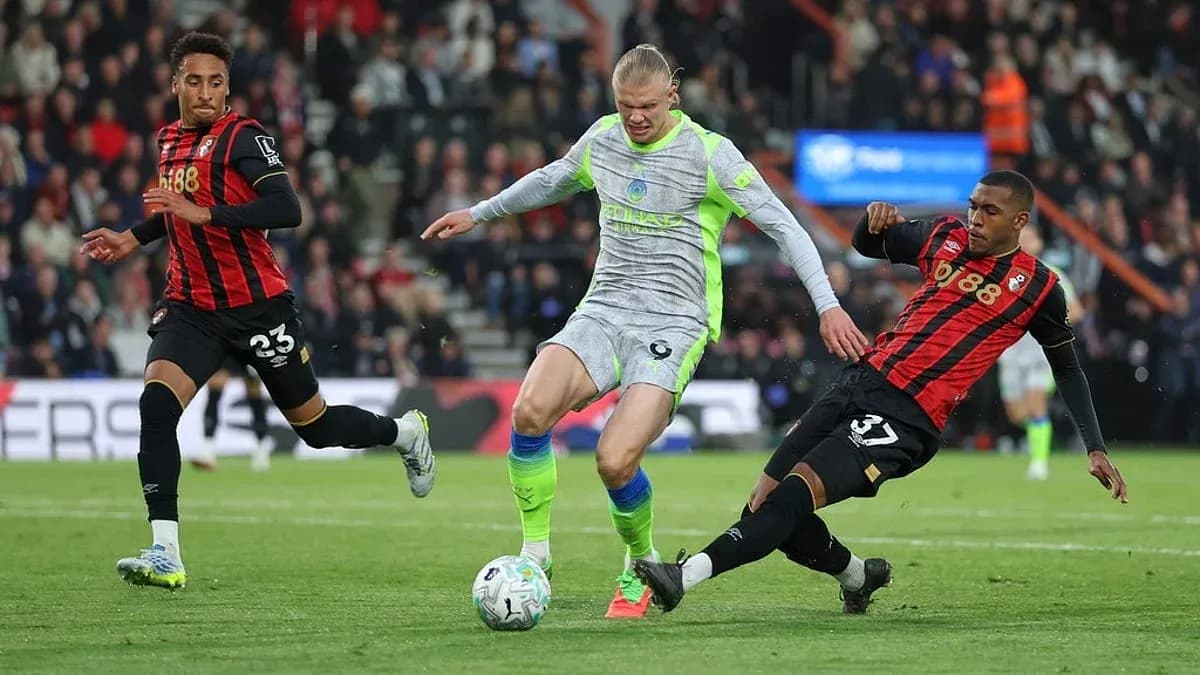
The headline duel was unavoidable: Erling Haaland against Bournemouth’s defensive block. Haaland entered as the league’s most prolific scorer, with 27 goals and 8 assists from 35 appearances, plus 102 shots (59 on target). He is not just a finisher but a volume shooter and penalty threat, having scored 3 spot-kicks but also missed 1. Against a Bournemouth side that, heading into this game, conceded 1.1 goals per match at home and kept 6 home clean sheets, this was the classic “Hunter vs Shield” scenario.
The shield was not a single player but a collective. Senesi’s left-footed aggression, Hill’s positional discipline and Truffert’s mobility created a compact central box in front of Petrovic. Tyler Adams and Alex Scott, the double pivot, were tasked with shrinking the spaces Haaland and the City midfield could exploit. Adams screened passing lanes into the striker, while Scott stepped out to press Mateo Kovacic and Bernardo Silva, disrupting City’s usual rhythm between the lines.
In the “Engine Room” battle, Rodri stood as City’s metronome, facing Bournemouth’s mix of craft and chaos. Rodri’s role as the lone pivot in the 4-1-4-1 meant he had to manage transitions against a Bournemouth side that, overall, scores 1.5 goals per game and fails to score in only 7 of 37 league matches. With Rayan, Eli Junior Kroupi and Marcus Tavernier operating behind Evanilson, Bournemouth had three different types of threat: Rayan’s vertical runs, Kroupi’s directness and finishing (13 league goals, 31 shots, 21 on target), and Tavernier’s ability to drift inside and combine.
Kroupi’s presence as Bournemouth’s top scorer gave the hosts a focal point between City’s lines. Starting as one of the three behind Evanilson, he repeatedly looked to attack the half-spaces around Nathan O’Reilly and M. Nunes, forcing City’s full-backs to think twice about overlapping and leaving Rodri isolated.
For City, the flanks were supposed to be their release valves. Jérémy Doku, wide left, and Bernardo Silva, nominally from the right but drifting in, aimed to stretch Bournemouth’s compact 4-2-3-1. But Bernardo’s season profile – 10 yellow cards, 49 tackles, 6 blocks and 21 interceptions – also underlines his dual role as both creator and enforcer. Here, he was often dragged into deeper, scrappier zones, a subtle victory for Bournemouth’s pressing scheme.
IV. Statistical Prognosis – What This Draw Says About Both Sides
Following this result, the numbers frame the narrative rather than contradict it. Bournemouth’s overall goal difference of +4 is modest compared to City’s +43, yet the match itself played closer to Bournemouth’s script than City’s. At home, Bournemouth average 1.5 goals for and 1.1 against; a 1–1 draw sits almost exactly on that curve. City, by contrast, usually overpower opponents with 2.1 goals per game overall and concede under 1, but here they were held to a single strike.
Defensively, City’s season-long solidity – 16 clean sheets overall, 7 on their travels – was tested by Bournemouth’s layered attacking unit. Even without Christie and Jiménez, Iraola’s side generated enough threat to pierce a back line featuring M. Guehi and A. Khusanov in the centre. Evanilson’s presence as a true number nine pinned City’s centre-backs, while the three behind him rotated cleverly to drag Rodri into wider areas, opening central pockets.
From an Expected Goals perspective (even without raw xG figures provided), the patterns suggest a relatively balanced ledger. Bournemouth, with their consistent scoring record and home resilience, likely produced a moderate but efficient xG, capitalising on the few clear chances they created. City, as usual, would have generated volume, but not the avalanche of high-quality opportunities they often enjoy against lesser opposition. Haaland’s season profile – high shot volume, strong on-target rate – implies he still found moments, but Bournemouth’s compactness and Petrovic’s positioning limited the quality of those looks.
The broader tactical verdict is clear. Bournemouth have matured into a side capable of bending but not breaking against elite opposition, using a well-drilled 4-2-3-1, disciplined late-game defending (even if card-prone), and the emerging star power of Kroupi to punch above their weight. City remain a juggernaut, but this draw underlines a vulnerability: when their 4-1-4-1 is denied central superiority and their wide players are forced into traffic, even their 76-goal attack can be reduced to grinding rather than slicing.
At the Vitality, Bournemouth did more than take a point off a title challenger; they offered a blueprint for how structure, discipline and targeted aggression can tilt the margins against one of Europe’s most finely tuned machines.