Bodo/Glimt's Tactical Masterclass in Extra Time Win Against Union St. Gilloise
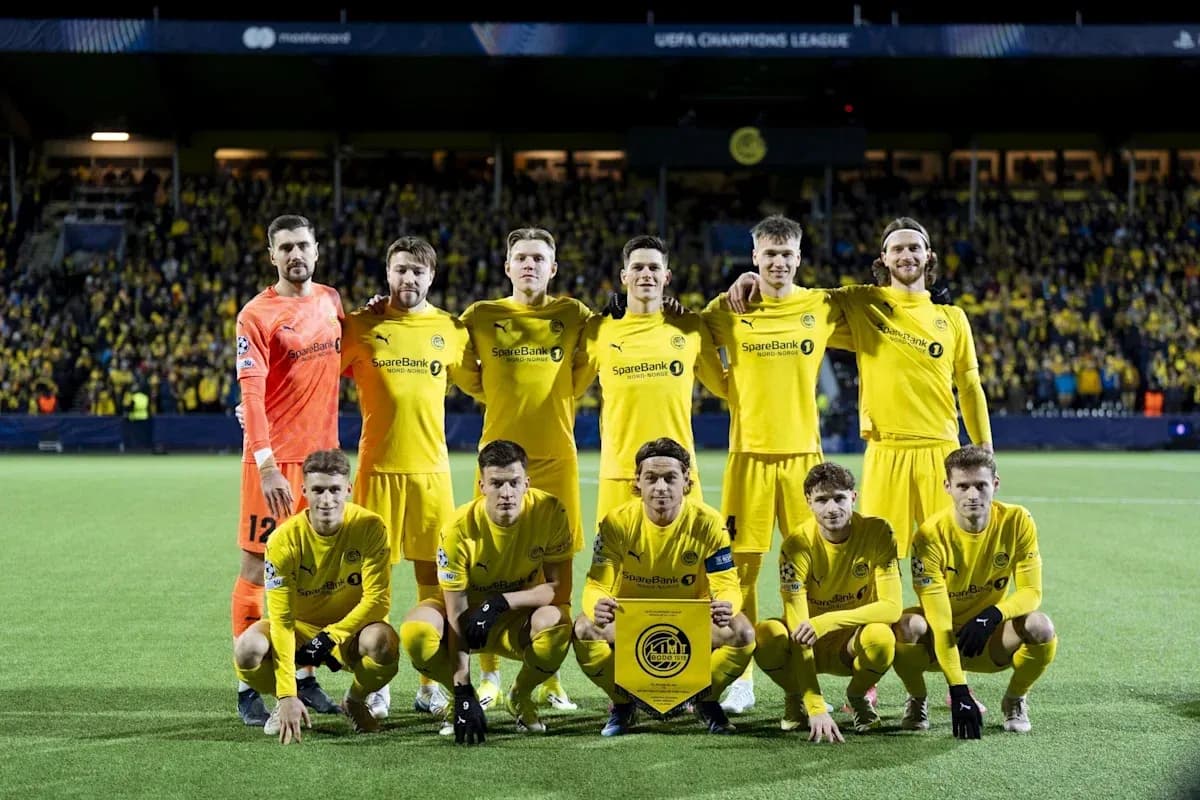
Bodo/Glimt’s 3-2 extra-time win over Union St. Gilloise at Aspmyra Stadion was a tactical siege resolved by depth, width and ball circulation against a compact, transition-oriented visitor. Across 120 minutes, Bodo/Glimt’s 4-3-3 under Kjetil Knutsen produced overwhelming territorial control and volume (70% possession, 23 total shots, 10 corners) but needed structural adjustments and bench impact to finally break a resilient 3-5-2 block.
From the outset, Bodo/Glimt’s 4-3-3 spacing was clear: full-backs F. Bjorkan and F. Sjovold pushed high to pin Union’s wing-backs, with S. Fet and Sondre Auklend operating as advanced interiors ahead of P. Berg. The hosts used their back four plus Berg as a five-man rest-defense platform, circulating through O. L. Bjortuft and J. Gundersen to draw out Union’s front two, then playing into the half-spaces for wingers O. Blomberg and J. Hauge. The 999 total passes with 889 accurate (89%) underline how committed Bodo/Glimt were to methodical progression, constantly recycling until a wide overload appeared.
Union St. Gilloise, in David Hubert’s 3-5-2, accepted life without the ball (427 passes, 335 accurate, 78%; 30% possession) and focused on verticality. The back three of N. Havenaar, M. Sylla and Kevin Mac Allister stayed narrow, with L. Patris and Guilherme Smith tasked with double roles: tracking full-backs and springing forward in transition. Centrally, K. Van De Perre and A. Zorgane tried to screen Berg and block central lanes, forcing Bodo/Glimt wide and into crosses or cut-backs where the three centre-backs could dominate aerially and in duels.
First Key Tactical Inflection
The first key tactical inflection came with the 51' opener: Bodo/Glimt’s wide rotations finally pierced the block as J. Hauge, starting from the left of the front three, found O. Blomberg, whose movement inside the right channel exploited the space behind Union’s wing-back. It was a textbook use of the 4-3-3’s far-side winger: Hauge’s assist came from the opposite flank, evidencing how the hosts switched play quickly enough to attack the weak side before Union’s midfield five could shuffle across.
Union’s response at 61' — moments after P. David (OUT) was replaced by M. Fuseini (IN) — was a clear tactical gambit: introduce a more direct, depth-running forward to stretch Bodo/Glimt’s high line. The equaliser by Guilherme Smith, assisted by D. Olaru, came from precisely that logic: fast use of the ball into advanced wide-midfield zones, then penetration into the box against a defense that had been camped high for long spells. It underlined Union’s plan: absorb, then strike quickly into the spaces Bodo/Glimt left in behind.
In-Game Management
Knutsen’s in-game management was decisive. At 70', he refreshed both midfield and attack: S. Auklend (OUT) for J. Kitolano (IN) and O. Brynhildsen (OUT) for A. Helmersen (IN). Kitolano added energy and forward runs from midfield, while Helmersen gave more penalty-box presence and link play. The payoff was immediate: at 76', Hauge scored from an A. Helmersen assist, a sequence that showed Bodo/Glimt’s capacity to create central combinations rather than relying only on crosses. Helmersen dropped between the lines, received and released Hauge into a scoring position — a pattern that became central in extra time.
Union’s 3-5-2 began to fray under the physical and mental strain. Kamiel Van de Perre’s first yellow at 81' for “Foul” reflected the growing difficulty of controlling Bodo/Glimt’s midfield rotations. Yet Union still found a way to 2-2 at 88', when M. Fuseini, the earlier substitute, finished from an L. Patris assist. Again, the pattern was direct and incisive: quick exploitation of Bodo/Glimt’s advanced full-backs and a more open central corridor as the hosts chased control rather than pure security.
Disciplinary Sequence
The 90+6' disciplinary sequence — yellow for Guilherme Smith (“Argument”), then yellow and red for Kamiel Van de Perre (both “Foul”) — crystallised the tactical story. Union’s midfield screen, already stretched, lost a key component, forcing an even deeper, emergency version of the 5-3-1/5-4-0 in extra time. With a man advantage, Bodo/Glimt could now pin Union in their box almost permanently, and the shot profile (23 total, 9 on goal) mirrors that territorial lock.
In extra time, Bodo/Glimt managed the load and structure intelligently. Defensive changes — J. Gundersen (OUT) for Haitam Aleesami (IN) at 41', then F. Bjorkan (OUT) for I. Maatta (IN) at 103' — kept the back line fresh without altering the 4-3-3 shape. In midfield, S. Fet (OUT) for U. Saltnes (IN) at 104' added a more experienced controller to steer the final phase. The cumulative effect was a side still capable of high-tempo circulation and pressing in the 110th minute onward, while Union were increasingly reactive.
The decisive 117' goal by A. Helmersen — unassisted — was the logical end-point of this tactical arc. Bodo/Glimt, facing a tiring, numerically inferior block, kept forcing play into the box (17 shots inside the area) until a central lane opened. Helmersen, already influential as a provider earlier, now attacked space himself, capitalising on second balls and broken structure in Union’s penalty area. That he scored after 117 minutes speaks to Bodo/Glimt’s fitness and the value of having a bench forward capable of both combining and finishing.
Goalkeeper Dynamics
Goalkeeper dynamics, while not the headline, framed the risk profiles. N. Haikin (Bodo/Glimt) faced 5 shots on goal and made 3 saves, operating largely as a high starting-position keeper behind an aggressive line. V. Chambaere (Union St. Gilloise) dealt with 9 shots on goal and produced 5 saves, repeatedly exposed by volume rather than clear structural collapse. Both teams’ “goals prevented” metrics are absent, but the raw saves numbers match the tactical patterns: Union’s keeper under siege, Bodo/Glimt’s exposed only in sharp transition moments.
Discipline and fouls (11 for Bodo/Glimt, 10 for Union) underscore that this was not a reckless pressing battle but a controlled dominance versus compact resistance. Bodo/Glimt’s two yellows — Sondre Auklend at 16' (“Foul”) and Haitam Aleesami at 92' (“Foul”) — came from isolated defensive interventions. Union’s four yellows and one red, concentrated late, reflected the cumulative strain of defending deep and chasing transitions with diminishing legs.
Overall, the tactical breakdown is clear: Bodo/Glimt’s structured 4-3-3, high passing volume and intelligent substitutions eventually overwhelmed Union St. Gilloise’s disciplined 3-5-2. The visitors’ plan of low block plus vertical counters was executed well enough to reach 2-2 in regulation, but the red card and Bodo/Glimt’s bench quality turned extra time into a controlled, inevitable siege that Helmersen finally converted into progression in the UEFA Champions League 3rd Qualifying Round.