Villarreal vs Sevilla: Tactical Analysis of a 2-3 Defeat
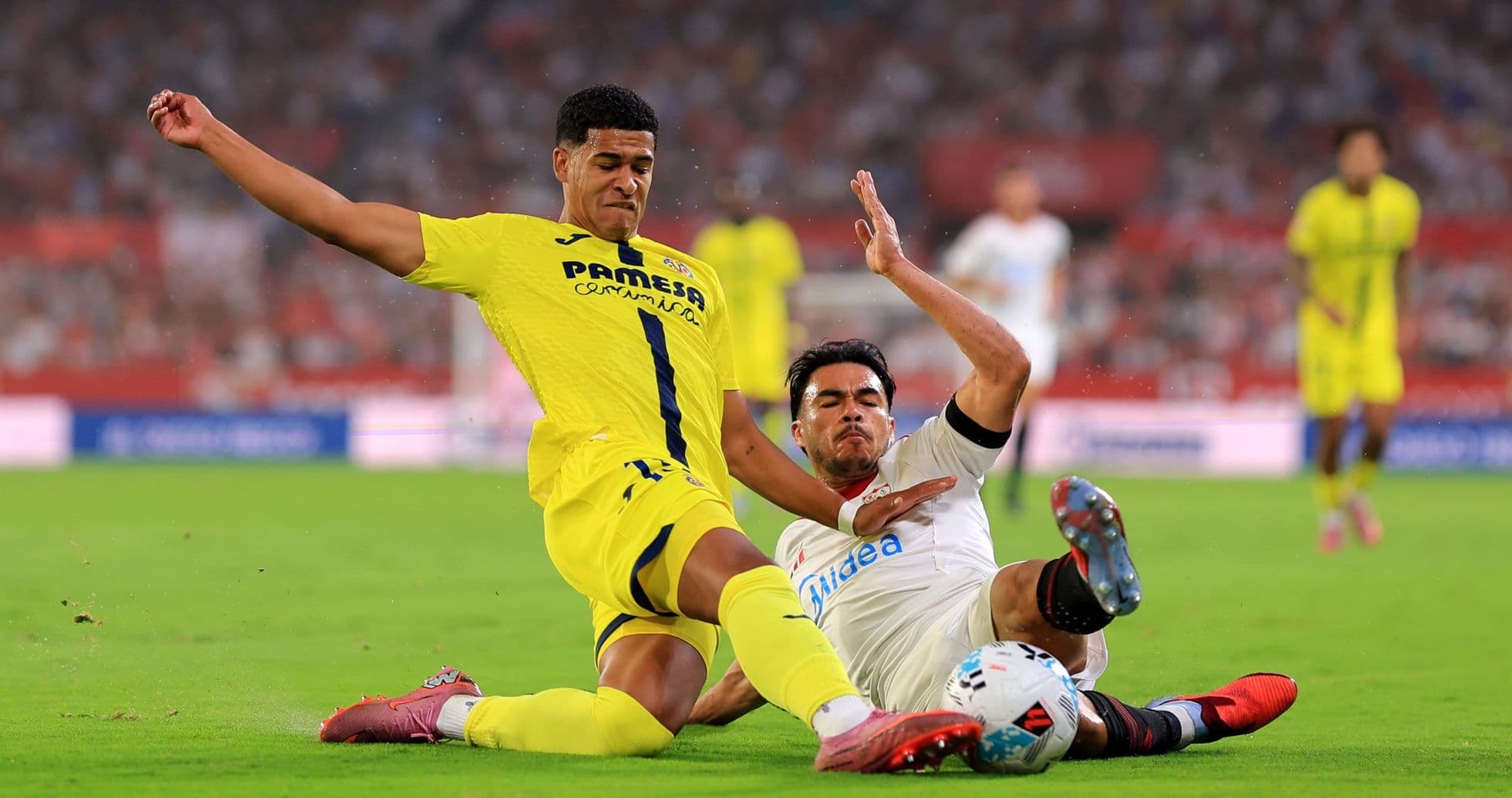
Villarreal’s 2-3 home defeat to Sevilla at Estadio de la Ceramica was a tactical swing match: Marcelino’s 4-4-2 started by overwhelming Sevilla’s 5-3-2, but Luis Garcia Plaza’s side gradually bent the game toward the type of contest their structure was built for. Despite Villarreal’s territorial dominance and 63% possession, Sevilla’s compact block, better shot volume and more incisive counter-attacks ultimately dictated the scoreboard in this La Liga Regular Season - 36 fixture.
By half-time, the score was already 2-2, reflecting a first period of drastic tactical momentum shifts. Villarreal struck first through two well-constructed attacks. On 13 minutes, Gerard Moreno finished a move that showcased the front pair’s synergy, converting from a pass by Georges Mikautadze. Seven minutes later, the roles inverted: Mikautadze scored, assisted by Alberto Moleiro at 20', as Villarreal’s 4-4-2 exploited the half-spaces between Sevilla’s wing-backs and outside centre-backs. Sevilla responded by adjusting their use of the back five and midfield line. Oso’s goal at 36', assisted by Lucien Agoume, came from Sevilla finding a route into advanced zones after recovering the ball and breaking Villarreal’s first press. Just before the interval, the comeback was complete: centre-back Kike Salas scored at 45', assisted by Rodrigo Vargas, capitalising on Sevilla’s superior set-piece structure and their ability to attack the second phase around Villarreal’s box.
Second Half Adjustments
The second half’s key tactical hinge arrived around the hour mark, when Villarreal tried to re-energise a midfield that had started to lose control of transitions. At 60', T. Partey (IN) came on for Pape Gueye (OUT), and Tajon Buchanan (IN) came on for Nicolas Pepe (OUT), signalling a clear attempt by Marcelino to add vertical running and more progressive passing from deep. Villarreal’s shape remained a 4-4-2, but with Partey as a more assertive pivot and Buchanan offering direct width and 1v1 threat.
Luis Garcia Plaza reacted by rebalancing Sevilla’s midfield and wing-backs. At 68', J. Sanchez (IN) replaced Rodrigo Vargas (OUT), freshening the right side and adding defensive legs to protect the lead-up zones where Villarreal were trying to overload. Villarreal doubled down on control at 70': S. Comesana (IN) replaced Dani Parejo (OUT), and Ayoze Perez (IN) replaced Mikautadze (OUT). This shifted Villarreal towards a more associative, possession-heavy approach between the lines, with Gerard Moreno and Ayoze both dropping into pockets, while Comesana and Partey tried to dictate tempo.
Sevilla, however, leaned further into transition football. At 72', Alvaro Sanchez (IN) replaced Neal Maupay (OUT), immediately preceding the decisive moment: at 72', Assan Adams scored Sevilla’s third, assisted by Djibril Sow. The goal embodied Sevilla’s tactical plan: absorb pressure, win the ball in midfield, then exploit the spaces left by Villarreal’s advanced full-backs and central overloads. With Villarreal pushing more men forward, Sevilla’s front two and midfield runners found larger channels to attack.
Closing Phase
The closing phase was about game management and discipline. Villarreal’s frustration surfaced at 81', when Ayoze Pérez received a yellow card — Foul. Sevilla then added further defensive security: at 86', Nemanja Gudelj (IN) came on for Sow (OUT), reinforcing the midfield screen, and Castrin (IN) replaced Adams (OUT), adding fresh defensive energy to protect the back line and wide areas. Villarreal’s late push brought another booking: at 90+2', Renato Veiga was shown a yellow card — Foul, reflecting late, risk-heavy defending in higher zones as Villarreal tried to compress the pitch. Sevilla’s final adjustment came with a clear time-management signal: at 90+3', José Ángel Carmona received a yellow card — Time wasting, underlining Sevilla’s shift from counter-punching to pure game control in the final minutes.
Statistical Overview
From a structural standpoint, Villarreal’s 4-4-2 was designed to dominate the ball and create high-quality central combinations. They succeeded in possession and circulation: 554 passes, 499 accurate (90%), and 63% of the ball. The double pivot (Parejo then Comesana alongside Gueye then Partey) allowed them to progress through Sevilla’s first line, and the wide midfielders plus full-backs created consistent width. However, Sevilla’s back five compressed their box effectively, forcing Villarreal into lower-value shooting positions: just 6 total shots, 4 on goal, and an xG of 0.81. The structure produced territory but not volume.
Sevilla’s 5-3-2, by contrast, accepted a deficit in possession (325 passes, 276 accurate, 85%, and 37% of the ball) in exchange for control of space. Their defensive index in this match was defined by compactness between the lines and aggressive coverage of the half-spaces. With three central midfielders screening and the back five holding a narrow line, they were able to limit Villarreal’s penalty-box entries and force many attacks wide or into blocked lanes (Villarreal had only 1 blocked shot). Offensively, Sevilla were more opportunistic but also more efficient in their shot creation: 13 total shots, 5 on goal, with 7 from inside the box and 6 from outside, generating 0.88 xG. The higher volume and variety of attempts reflected how well their transitions and set-piece routines were tuned to exploit Villarreal’s structural risks.
In goal, both keepers had relatively light but telling workloads. A. Tenas made 2 saves for Villarreal, with goals prevented at -0.22, indicating he conceded slightly more than an average keeper might be expected to from the shots faced. O. Vlachodimos, for Sevilla, registered 1 save and also a goals prevented figure of -0.22, suggesting that although Villarreal did not shoot often, the quality of their on-target efforts was reasonably high and that Sevilla’s keeper was marginally below par in pure shot-stopping terms. However, Sevilla’s defensive block reduced his exposure by keeping Villarreal’s total shot count low.
Discipline also aligned with the tactical story. Villarreal finished with 2 yellow cards (Ayoze Pérez — Foul at 81', Renato Veiga — Foul at 90+2'), Sevilla with 1 (José Ángel Carmona — Time wasting at 90+3'), for a total of 3 cards. Villarreal’s bookings reflected frustration and late challenges in a match they were chasing; Sevilla’s single caution underlined a side in control of the scoreboard, more concerned with managing time than contesting duels recklessly.
Statistically, the verdict is clear: Villarreal’s overall form in this match was possession-dominant but chance-poor. Their high pass accuracy and territorial control did not translate into enough shots or xG to justify a win. Sevilla, with fewer passes and less of the ball, produced more attempts, a slightly higher xG, and used their 5-3-2 to maximise transition value and set-piece threat. The 2-3 scoreline, with Villarreal leading 2-0 then conceding three unanswered, encapsulates a tactical reversal where Sevilla’s structure and in-game adjustments proved more efficient and better aligned with the demands of the contest.