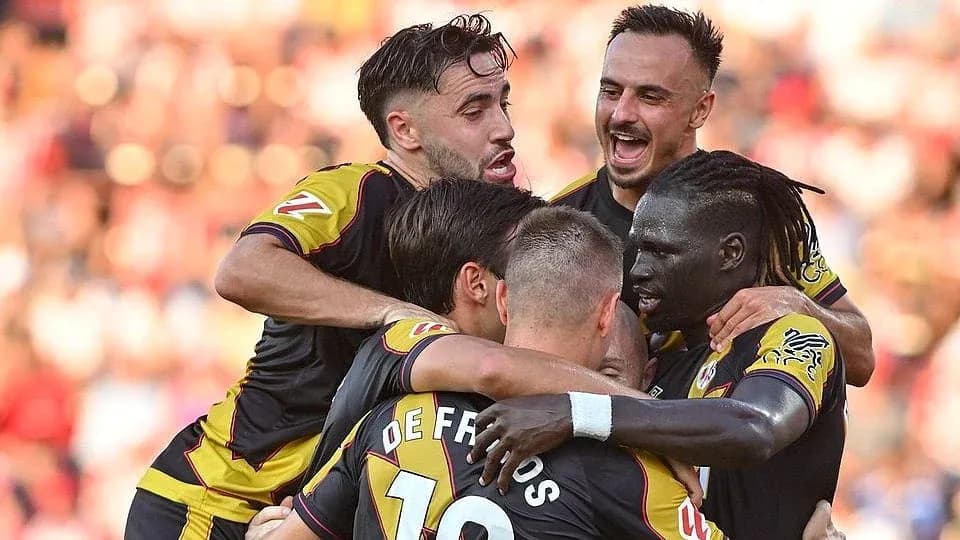
Rayo Vallecano vs Girona: Tactical Analysis of the 1–1 Draw
The night at Campo de Futbol de Vallecas ended level on the scoreboard, but not in the storylines. Following this result – a 1–1 draw in Round 35 of La Liga – Rayo Vallecano and Girona walked away with very different sensations: the hosts consolidating a solid mid‑table identity, the visitors clinging to survival with a point that felt both precious and fragile.
I. The Big Picture – contrasting trajectories
Heading into this game, the table framed the narrative. Rayo Vallecano sat 10th with 43 points, their overall goal difference at -6 (36 scored, 42 conceded). They have been defined by balance and stubbornness: in total this campaign they had played 35 matches, winning 10, drawing 13 and losing 12. At home they were one of La Liga’s more awkward assignments – 18 matches, only 2 defeats, 6 wins and 10 draws, with 22 goals for and 15 against. An average of 1.2 goals scored at home and just 0.8 conceded underlined their identity: cautious but controlled.
Girona arrived in Madrid with a very different burden. They were 18th on 39 points, their overall goal difference a worrying -15 (37 for, 52 against). In total this campaign they had lost 14 of 35 league games, and the defensive record told its own story: they conceded 1.5 goals per game both at home and on their travels. Away, they had been competitive but fragile – 3 wins, 8 draws, 7 defeats, 18 scored and 27 conceded.
On paper, then, this was a meeting between a side that knows how to manage games at home and a relegation-threatened visitor whose margins are relentlessly thin.
II. Tactical Voids – absences that reshaped the chessboard
The team sheets revealed how much both coaches had to improvise.
Rayo Vallecano were without I. Akhomach (muscle injury), Luiz Felipe (injury), D. Mendez (knee injury) and, crucially, I. Palazon, suspended after a red card. Palazon is not only one of Rayo’s creative hubs – 3 goals, 3 assists and 39 key passes in the league – but also their emotional barometer, a player who has drawn 51 fouls and lived on the disciplinary edge with 10 yellows and 1 red. His absence forced Inigo Perez to lean into a more collective attacking structure in the 4‑3‑3, with J. de Frutos and S. Camello carrying the attacking responsibility.
Girona’s voids were even more disruptive. B. Gil (suspension for yellow cards), Juan Carlos, Portu and V. Vanat all missed out through injury, as did D. van de Beek and the curious absentee M. ter Stegen, listed under Girona’s umbrella but unavailable with a hamstring injury. That stripped Michel of experience at both ends of the pitch and narrowed his options for game-state management, especially late on.
Discipline has been a recurring subplot for both clubs. Heading into this game, Rayo’s yellow-card profile was spread across the match but peaked between 61–75 minutes with 19.39% of their yellows, and they showed a real tendency for late red drama: 33.33% of their reds arriving in the 91–105 minute window. Girona, by contrast, were serial offenders late in games: a huge 39.19% of their yellows came between 76–90 minutes, and 17.57% in 91–105, underlining how often they lose control when fatigue and pressure converge.
III. Key Matchups – Hunter vs Shield, Engine Room vs Enforcer
The “Hunter vs Shield” duel was embodied by Jorge de Frutos against Girona’s back line. De Frutos came into the fixture as Rayo’s leading scorer in La Liga with 10 goals and 1 assist from 33 appearances. His profile is that of a direct, volume winger: 47 shots, 26 on target, and 53 dribbles attempted with 26 successful. He thrives on isolation situations, where his 248 duels (106 won) and 36 fouls drawn show how often he drags defenders into uncomfortable territory.
Waiting for him was a Girona defence anchored by Vitor Reis – listed in the disciplinary data as Vitor Nunes – a 19‑year‑old centre-back whose season has been a mixture of promise and rawness. Across 33 appearances, he had made 38 successful blocks and 30 interceptions, with 266 duels and 154 won. He is proactive, sometimes to a fault, and already has a red card on his record. In this match, his ability to step out and block De Frutos’ shooting lanes, while not overcommitting, was central to Girona’s survival plan.
In the “Engine Room”, the duel was more nuanced. Rayo’s midfield trio of P. Diaz, O. Valentin and U. Lopez had to compensate for the missing Palazon’s creativity. Diaz offered positional discipline in front of the defence, Valentin the shuttling energy, and Lopez the passing angles between the lines.
Opposite them, Girona’s double pivot of A. Witsel and F. Beltran in the 4‑2‑3‑1 was built for control and circulation rather than chaos. Witsel’s metronomic passing and Beltran’s mobility were tasked with bypassing Rayo’s first line of pressure and feeding the advanced trio of V. Tsygankov, T. Lemar and J. Roca behind A. Ounahi. This structure was designed to stretch Rayo’s compact block laterally, forcing their full-backs – especially A. Ratiu – into difficult decisions between stepping out and protecting the half-spaces.
Ratiu himself carried his own subplot. One of La Liga’s most active full-backs this season, he had produced 41 key passes, 66 tackles and 6 successful blocks, while collecting 9 yellow cards. His willingness to drive forward and attempt 112 dribbles (59 successful) is a vital part of Rayo’s width, but it also leaves space behind him – a zone Girona’s wide playmakers looked to exploit.
IV. Statistical Prognosis – xG logic vs survival instinct
Even without explicit xG values, the season’s numbers offered a clear probabilistic script. Heading into this game, Rayo’s home averages – 1.2 goals scored and 0.8 conceded – pointed to a low-scoring contest they would typically tilt in their favour or at least control. Girona’s away profile – 1.0 scored and 1.5 conceded on their travels – suggested they would need efficiency and set-piece or transition moments rather than prolonged dominance.
Rayo’s 11 clean sheets overall, 7 of them at home, combined with Girona’s mere 1 clean sheet away, made a home goal more likely than not. Yet Girona’s 12 away draws in total (8 of 18 on their travels this campaign) underlined their knack for dragging games into stalemates when survival is at stake.
The 1–1 full-time scoreline fits almost perfectly into those statistical grooves: Rayo’s controlled but not ruthless attack, Girona’s porous but stubborn defence, and the visitors’ tendency to cling on late despite disciplinary volatility.
Following this result, Rayo remain the archetype of a mid-table side with a clear defensive structure and a couple of standout individuals – De Frutos in attack, Ratiu and P. Ciss as high-impact, high-card protagonists. Girona, meanwhile, stay defined by contradiction: structurally coherent in a 4‑2‑3‑1, buoyed by talents like Vitor Reis and Tsygankov, yet trapped in a relegation fight because their defensive averages refuse to budge.
On a warm night in Vallecas, the numbers and the narrative aligned: one point each, but very different futures still to be written.