Korea's World Cup Countdown: Doubts and Hopes
Thirty days from a World Cup that stretches across a continent, Korea finds itself staring into a mirror it does not much like.
The countdown has hit the one‑month mark in Korea, yet belief around the men’s national team is scraping the bottom. The Taegeuk Warriors are going to the biggest World Cup ever staged, but they go wrapped in doubt.
A coach under siege, and empty seats
The mood turned sour the moment Hong Myung-bo was handed the reins in the summer of 2024. His appointment was controversial, his approval ratings abysmal, and the stands quickly became a weekly referendum on the Korea Football Association.
When fans did come, they made sure everyone heard them. Hong was booed relentlessly. Banners demanding the resignation of KFA president Chung Mong-gyu were held aloft in packed stadiums that once felt like automatic sellouts for the national team.
Then came something even more damning than jeers: silence.
On Oct. 14, only 22,206 people walked through the gates of the 66,000-seat Seoul World Cup Stadium for a friendly against Paraguay — the lowest attendance for a men’s international there in a decade. A month later, on Nov. 18, just 33,256 turned up at the same venue to watch Korea face Ghana. Respectable numbers on paper, but in Seoul, for this team, they felt like a boycott.
Korea won both games, with a victory over Bolivia in Daejeon wedged between them in front of around 33,000 fans. The scorelines were kind; the performances were not. The football never matched the results, and the skepticism lingered.
Then the World Cup year began, and the results finally caught up.
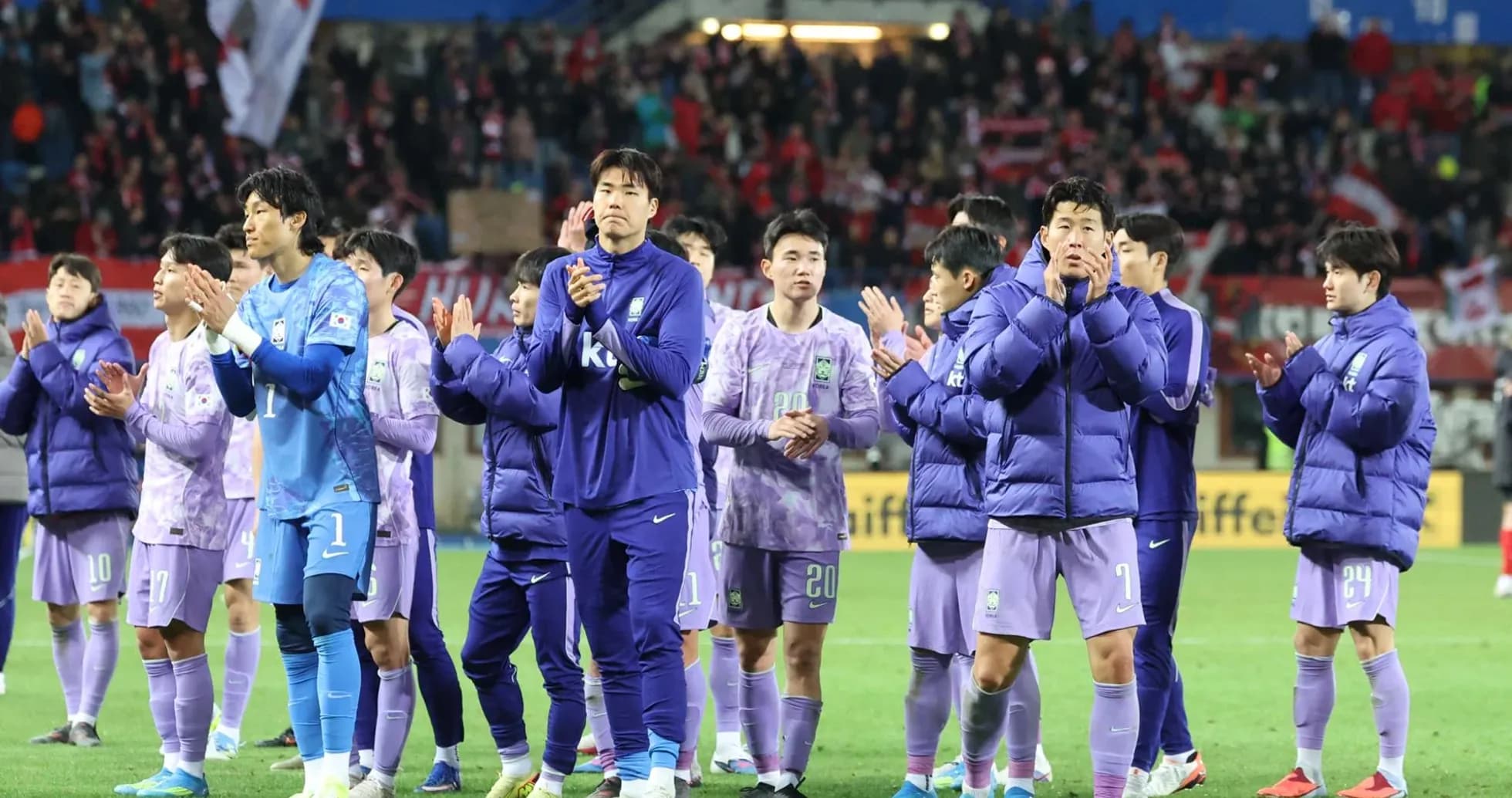
A 4-0 humbling by Ivory Coast on March 28 was followed three days later by a 1-0 defeat to Austria, both away from home. Two matches, no goals, and the sense that the wheels were not just wobbling but might already be off.
A soft draw, on paper
All this angst surrounds a team that, on ranking and on paper, should still fancy its chances.
World No. 25 Korea landed in what many pundits have already labeled one of the softer groups. Group A brings 15th-ranked Mexico, 41st-ranked Czechia and 60th-ranked South Africa. No Brazil, no France, no Argentina. No one from the very top shelf.
The schedule does Korea a favor too.
They open against Czechia in Guadalajara at 8 p.m. on June 11 (11 a.m. on June 12 in Korea). Mexico follow in the same city at 7 p.m. on June 18 (10 a.m. on June 19 in Korea). The group stage closes with South Africa in Monterrey at 7 p.m. on June 24 (10 a.m. on June 25 in Korea).
Three games, all in Mexico. Two in the same stadium. Minimal travel in a tournament spread across Mexico, Canada and the United States. In a World Cup of long flights and short turnarounds, Korea’s route is relatively gentle.
This is also a new kind of World Cup: 48 teams instead of 32, and a knockout phase that starts at the round of 32. The top two from each of the 12 groups advance, joined by the eight best third-placed sides.
The bar to reach the knockouts has never been lower. That is why many experts still expect Korea to emerge from the group. How much further they can go is where opinions split.
History, hope and a thin margin
This will be Korea’s 11th consecutive World Cup. Away from home, they have escaped the group twice: in South Africa in 2010, and in Qatar in 2022. The pedigree is there. So is the scar tissue.
Television analyst Kim Dae-gil sees a path that leads at least to the round of 16.
“I think Korea will get to at least the round of 16,” Kim said. He looked at the group and saw opportunity rather than danger. In his view, Korea “won’t have to expend as much energy as in some previous tournaments,” and can beat Czechia and South Africa “six times out of 10.” Finish first or second, he argued, and the round of 32 should bring a beatable opponent.
For Kim, the trump card is obvious: star power.
Captain Son Heung-min, now with Los Angeles Football Club, and Paris Saint-Germain playmaker Lee Kang-in are the players who can twist a match in a moment. They can create something from nothing. At a World Cup, that is often what separates survival from exit.
Yet even Kim’s optimism comes with a warning label.
“The gap between the starters and backups is substantial,” he said. The depth behind Son and Lee troubles him. To push beyond the round of 16, he believes Korea need supporting players who can carry the load when the stars tire or are tightly marked. Above all, he stressed, it is “imperative” that someone like Son stays healthy.
Injuries, form and a harsher verdict
Not everyone shares Kim’s relatively upbeat outlook.
Analyst Seo Hyung-wook started out believing this Korea side could make the round of 16. Then came the ankle injury to midfielder Hwang In-beom, and his forecast shifted down a level, to a round-of-32 exit.
Hwang, a clever two-way midfielder, is as close to irreplaceable as anyone in Hong’s squad. He injured his right ankle in March while playing for Feyenoord and is now rehabbing with the help of the national team medical staff. His status looms over everything.
“Other mainstays have not been playing well,” Seo said. Lee Kang-in and Bayern Munich defender Kim Min-jae have both struggled for minutes at their clubs. That lack of rhythm bleeds into national-team form.
Seo still sees a core strength in the chemistry among Europe-based players like Son, Lee and Kim, who have built an understanding over years together. The problem, in his eyes, is quantity.
“The problem is there just aren’t many of them,” he said. At this moment, he argued, it is hard to point to anyone in the squad and say they will perform at a truly world-class level at this World Cup.
Analyst Park Chan-ha sits in the same camp of caution. He also predicts Korea will bow out in the round of 32.
“Hong Myung-bo’s team has some talented players,” Park said. Yet the attack, he argued, often stutters. Korea struggle to manufacture chances through structure and patterns; they lean heavily on individual brilliance when those rare openings appear. At a World Cup, where margins shrink and defenses tighten, that approach has limits.
“I think we already saw problems with this approach in the two losses in March,” Park added. If Hwang cannot play, or is restricted, Park expects those problems to deepen.
One group, one hinge point
For Park, the entire campaign may pivot on the first night in Guadalajara.
“I think the first match against Czechia will be the most important one,” he said. “This is the one Korea must win, and they will be in trouble if they don’t get it done.” Czechia, he noted, are not naturally attack-minded. They sit, they block, they wait. Breaking them down will test all of Korea’s creativity — and expose any lack of it.
Seo agrees that the opener carries huge weight.
“In our World Cup history, the outcome of the first match often determined the fate for the rest of the tournament,” he said. With Mexico looming in the second game, he sees little margin for error. Fail to win against Czechia, and the mountain becomes steep very quickly. “Mexico will be a tough test in the second match, and if we don’t win the first match, we will be in big trouble.”
Kim Dae-gil sees it differently. For him, the decisive chapter comes a week later.
He believes the clash with Mexico will ultimately define the group. “I think Korea and Mexico will battle for the top spot in the group,” he said. If he is right, that second match is not just a hurdle but a prize fight for seeding, momentum and perhaps a smoother path through the new, expanded knockout maze.
So Korea stand here: a soft draw, a forgiving travel schedule, a record of making it out of groups abroad, and a fan base that no longer trusts what it sees. A coach under siege, stars under pressure, and a midfield linchpin racing the clock.
In 30 days, the noise will stop and the football will have to answer. Will this be another step forward on foreign soil, or the tournament that confirms the doubts that have been echoing around half-empty stands?