
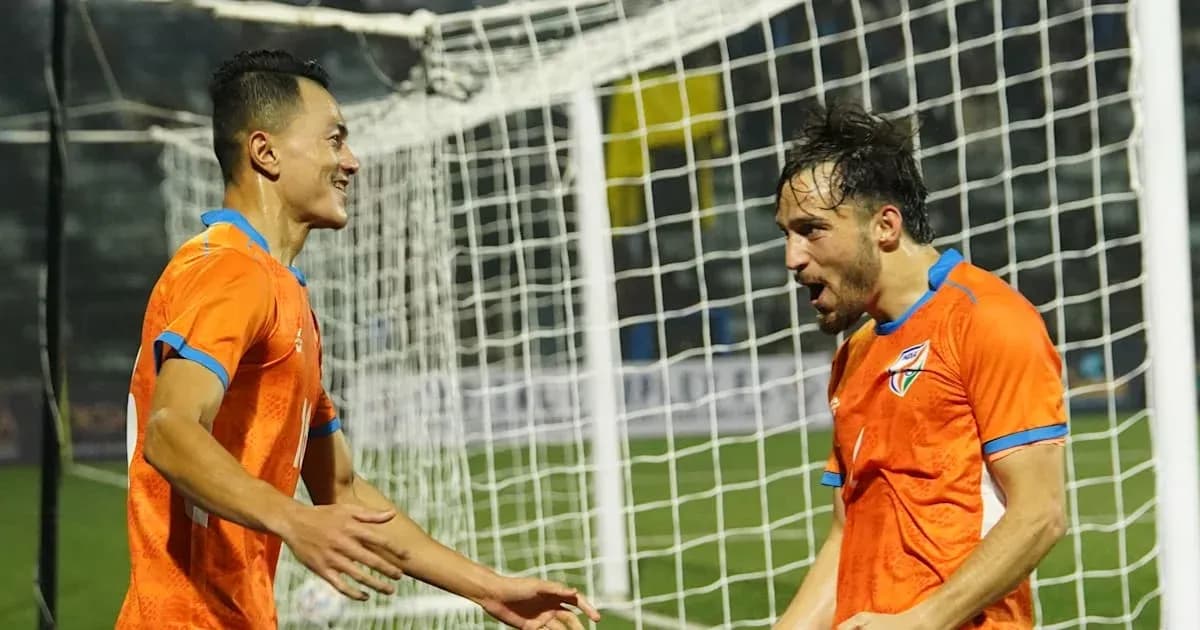
India's Depleted Squad Faces Jamaica in Unity Cup Semi-Final
The last time India’s men’s football team played on British soil, Sunil Chhetri was a teenager and the sport lived in a very different corner of the country’s imagination. That was 2002. Twenty-four years later, an injury-hit, call-up-ravaged squad walks into The Valley in London for the Unity Cup 2026 with more questions than certainties – and a heavyweight waiting on the other side.
India, ranked 136th in the world, face Jamaica, ranked 71st, in the second semi-final in the early hours of Thursday. Kick-off is at 12:00 AM IST on May 28, all of it unfolding at the home of Charlton Athletic, a traditional English ground that has seen its share of underdogs and upsets.
This time, India are very much the underdogs.
A tournament of contrasts
The Unity Cup line-up tells its own story. Nigeria, the African giants sitting 26th in the FIFA rankings. Zimbabwe, ranked 130th, looking for a foothold back on the international stage. Jamaica, packed with pace and physicality. And then India, arriving in London with just 18 players and a midfield stripped to the bare bones.
The format is simple. Two semi-finals, then a final and a third-place play-off. Win on Thursday and India are in the final. Lose, and they drop into the battle for third on May 30. Nigeria face Zimbabwe in the first semi-final at 12:00 AM IST on May 27, setting the tone for a compact, high-stakes tournament.
For Khalid Jamil, the tone was set even earlier – in the national camp, when his plans were torn up mid-preparation.
Mohun Bagan withdrawals rip through the squad
Mohun Bagan Super Giant’s decision to withdraw seven of their players from the national camp has left Jamil with a squad that looks more like a patched-up pre-season group than a full-strength national team.
The absentees are not fringe names. Lalengmawia Ralte, Sahal Abdul Samad, and Anirudh Thapa – three midfielders central to India’s recent evolution – are all missing. So are goalkeeper Vishal Kaith, defender Abhishek Singh Tekcham, and forwards Manvir Singh and Liston Colaco.
Take those seven out of any national side and you feel it. Take them out of a squad that already has limited depth, and you are left rearranging the entire spine.
Ashique Kuruniyan’s injury has only deepened the midfield crisis. With him out, Jamil travels with just three recognised central midfielders: Jeakson Singh Thounaojam, Noufal PN and Ricky Shabong. Jeakson is the established presence. Noufal and Ricky are still waiting for their first senior cap.
That is not rotation. That is a gamble forced by circumstance.
A thin midfield, a bold front line
The shortage in midfield will define how India approach Jamaica. Jeakson’s role becomes enormous – screening, recycling, calming. Around him, Jamil must decide how much risk he can afford with two uncapped midfielders against a Jamaican side that will test India’s structure and legs.
Higher up the pitch, the picture is brighter.
Ryan Williams and Lallianzuala Chhangte are expected to lead the line, offering pace, direct running and a willingness to take defenders on. Chhangte’s ability to stretch play and Williams’ work rate give India a platform to counter, even if they spend long spells without the ball.
Edmund Lalrindika arrives on the back of an ISL-winning campaign with East Bengal and carries something every coach craves – momentum. His confidence, his touch, his decision-making under pressure have all been sharpened by a title run. Jamil will hope that form translates quickly onto international turf.
Behind them, Rahim Ali and Farukh Choudhary add depth and industry in attack, the sort of forwards who can press, chase and occupy defenders when India are forced into long defensive phases.
Experience at the back, questions everywhere else
If there is comfort anywhere in this squad, it lies in goal and at the heart of defence.
Gurpreet Singh Sandhu, India’s most experienced goalkeeper, anchors a goalkeeping unit that also includes Hrithik Tiwari and Albino Gomes. In front of him, Sandesh Jhingan remains the defensive leader, the organiser and emotional reference point in a back line that will have to withstand long Jamaican spells.
The defensive options around Jhingan and Gurpreet are varied if not lavish: Rahul Bheke, Nikhil Poojary, Roshan Singh Naorem, Akash Mishra, Bijoy Varghese and Pramveer. Bheke’s versatility, Poojary’s energy on the flank, Mishra’s left-footed balance – all of it will be needed to stitch together a resilient unit.
They will not have the luxury of an overloaded bench. They will have to make every tackle, every clearance, every recovery run count.
The stage, the stakes, the screens
For Indian fans, the Unity Cup is a late-night watch. Every match streams live on FanCode, with no television broadcast in the country. Those who tune in at midnight will not be watching a full-strength India, or a polished, long-term project.
They will be watching a squad stripped down to essentials, playing its first game in Britain in more than two decades, thrown into a mini-tournament alongside Nigeria, Zimbabwe and Jamaica.
The official list tells its own story:
- Goalkeepers: Gurpreet Singh Sandhu, Hrithik Tiwari, Albino Gomes
- Defenders: Rahul Bheke, Nikhil Poojary, Roshan Singh Naorem, Sandesh Jhingan, Akash Mishra, Bijoy Varghese, Pramveer
- Midfielders: Jeakson Singh Thounaojam, Noufal PN, Ricky Shabong
- Forwards: Ryan Williams, Edmund Lalrindika, Lallianzuala Chhangte, Rahim Ali, Farukh Choudhary
Eighteen names. No safety net.
India arrive in London under-strength, under-sized on paper, and under little illusion about the challenge. But tournaments like the Unity Cup have a habit of bending expectations. If this patched-up side can find organisation at the back, courage in midfield and a cutting edge from Williams, Chhangte and Lalrindika, The Valley might just witness the start of a very different conversation about India’s depth – and about who steps up when the regulars are nowhere in sight.





