Hannibal Mejbri: The Heartbeat of Tunisia's Eagles of Carthage
The Eagles of Carthage have carried one of football’s great nicknames for generations. Now they have a Hannibal to match the mythology.
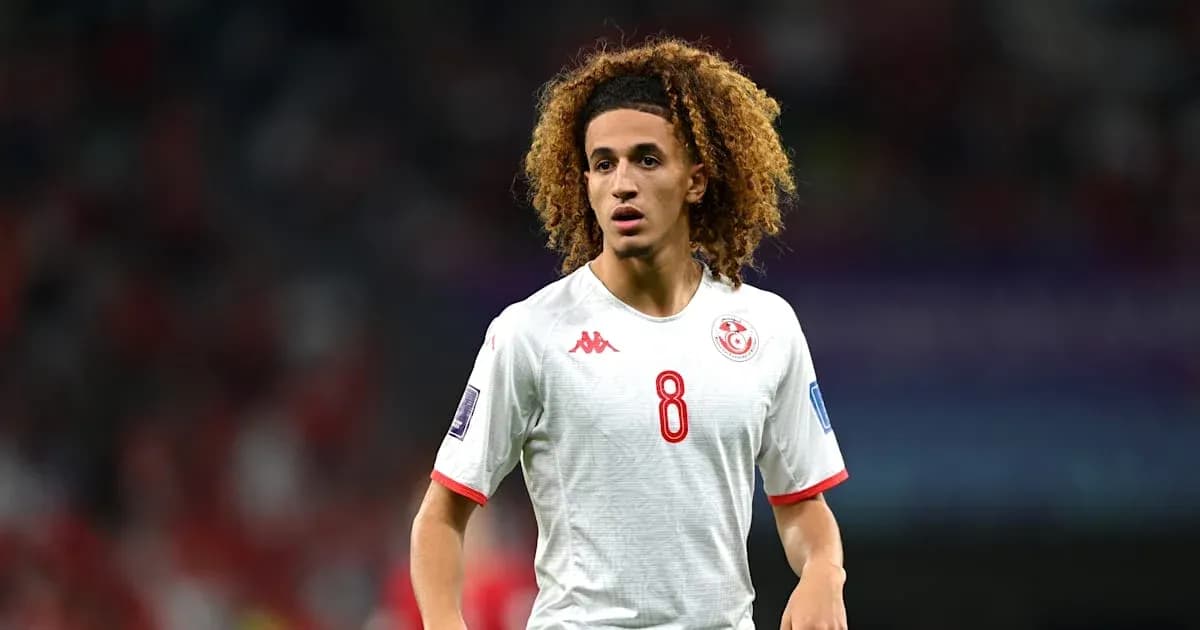
Not the general who drove war elephants over the Alps and stared down Rome, but a 23-year-old midfielder with wild blond curls and a stubborn streak to go with them. Hannibal Mejbri has become the heartbeat of a Tunisia side chasing a historic breakthrough at the FIFA World Cup 2026, desperate to finally climb out of the group-stage valley that has stopped every previous Tunisian campaign.
From La Banane to the world
To understand how he got here, you start far from Carthage. You start in Paris’ 20th arrondissement.
Mejbri was born in the French capital to Tunisian parents and raised in one of the city’s most densely packed, working-class districts. It is a neighbourhood stitched together by migration and memory: Tunisians, Algerians, Moroccans, Senegalese, Malians. Different flags, same soundtrack. Football.
The area’s most famous landmark is a curved block of flats known simply as La Banane — the Banana. Concrete, cramped, and for a young Hannibal, a playground.
“Instead of going straight up to my house, I used to stay out and play football until night fell,” he recalls in the series World at Their Feet, which tracks emerging talent on the road to the 2026 World Cup. No academy blueprint. No grand design. “I was a normal boy, there was no master plan. I had my friends, I was focused on my life as a kid.”
Those friends remember something different. They remember a kid you couldn’t miss.
Childhood friend Hubert Mbuyi talks about the football, of course, but also the look. “He had a unique style, with big hair, big blonde hair. So everyone knew him and had a lot of expectations for him.” If there was a ball and a patch of ground, Mbuyi says, “you will find Hannibal.”
The streets of La Banane became his first training ground. The noise, the tight spaces, the games that never really ended. That is where the future leader of the Eagles of Carthage learned to live with attention and expectation long before a television camera ever found him.
Paris, Monaco, Manchester: a fast climb
The formal journey began early. At six, Mejbri joined the academy of Paris FC, a club that has quietly built a reputation for spotting talent in the capital’s overlooked corners. He spent close to seven years there before a short spell at Boulogne-Billancourt.
Then came the first big leap.
In 2018, Monaco, specialists in polishing young prospects, paid €1 million to bring the 15-year-old into their academy. For a kid from La Banane, the contrast hit hard.
“I could feel the richness of Monaco,” he says. “So yeah, it was a little bit of a shift, a little dream, and I learned a lot there.”
The experience was not perfect. By his own admission, he did not have the best of times on the Riviera. But the talent was impossible to ignore. Scouts from Bayern Munich, Paris Saint-Germain and Barcelona tracked his progress. The queue of suitors grew.
When the moment came, he chose Manchester United.
In August 2019, at just 16, Mejbri signed for the three-time Champions League winners. Old Trafford has swallowed up many promising youngsters, yet he rose quickly through the ranks. By 2021, he had his Premier League debut. Two years later, in September 2023, came the moment every young attacking player dreams of: a first top-flight goal.
It arrived in a 3–1 home defeat to Brighton. United were already three down when the ball fell for him. He struck, scored, and something inside him snapped free.
“I still get chills,” he says. “I don’t know why I started to celebrate when we were losing 3–0, and you can see in my celebration that I had a certain rage in me and that I let go of everything when I scored.”
The goal did not change the result. It did reveal something about the player. Pride, defiance, refusal to accept the script. Traits that now serve Tunisia on the biggest stage.
Choosing Tunisia with his heart
Mejbri’s international choice was always going to be a story.
He wore the blue of France at under-16 and under-17 level, a natural pathway for a Paris-born prospect. Yet when Tunisia called in 2021, he turned towards his parents’ homeland and never looked back.
“I joined Tunisia because I chose with my heart,” he explains. “Even though I lived in France, it doesn’t take away the love I have for France. But I find that the love I have for Tunisia is greater.”
That decision has already shaped his career. Still just 23, he has amassed 44 caps and become a central figure for the Eagles of Carthage. His impact has been recognised across the continent: he has twice been named African Revelation of the Year at the Africa d’Or awards.
Every time he pulls on the red shirt, he carries more than a flag.
“When I represent my country, I also represent my neighbourhood,” he says. La Banane is never far from his thoughts. “Because I know that I will represent them, and so all of that, it’s a bit related to pride.”
Back home, they feel that connection. They see the kid who refused to come in when the streetlights flickered on, now lining up at World Cups.
“All Tunisians are proud of him,” says Mbuyi. “Because in the end, he’s a kid from the neighbourhood. When he plays matches, everyone focuses on the match. We’re all watching Hannibal’s hair on the pitch. We try to spot him every time.”
Giving back to La Banane
For many players, the path out of the neighbourhood is one-way. Mejbri has made sure his isn’t.
Every summer, he returns to La Banane and organises a football tournament for the community that raised him. He funds it, he fronts it, he turns up. Last year, he handed out around 100 shirts.
The impact is visible in the stairwells and courtyards where he once played. “You can just walk around here and find two or three people wearing his shirt,” Mbuyi says.
For the kids chasing a ball where he once did, he is no longer just the local boy who made it to Manchester or the young star driving Tunisia forward. He has become a mirror of their own ambitions.
“Hannibal is a great example of what the people look for in this area,” Mbuyi adds. “Because of him, the young kids can dream.”
Now the stakes rise again. The World Cup stage, the weight of a nation, the chance to take Tunisia somewhere it has never been before. Two thousand years after another Hannibal tried to conquer the impossible, this one steps into the arena with a different kind of army behind him — a country, a neighbourhood, and a block of flats shaped like a banana, all pushing him towards the next mountain.