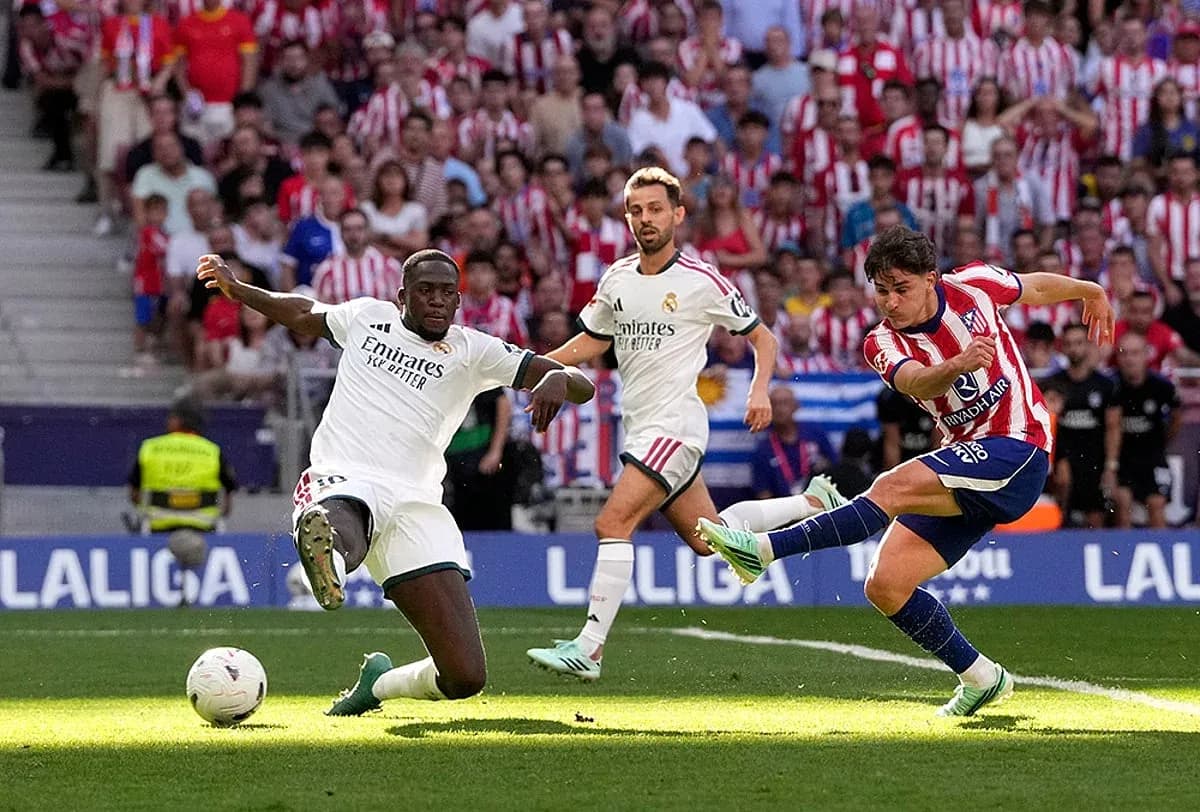
Atletico Madrid Edges Osasuna in Late-Season Clash
The night had the feel of a crossroads at Estadio El Sadar. Regular Season - 36 in La Liga, a late‑season fixture with very different pressures: Osasuna, 12th with 42 points and a goal difference of -4 (43 scored, 47 conceded overall), seeking to lock down mid‑table security and restore pride; Atletico Madrid, 4th on 66 points with a goal difference of 21 (60 for, 39 against overall), protecting their Champions League berth. Following this result, the 2-1 away win for Atletico underlined the gap in competitive edge between a side clinging to comfort and one still living in the tension of elite qualification.
Tactical Overview
Tactically, the contest was framed by the teams’ seasonal DNA. Osasuna leaned again on their staple 4-2-3-1, a shape they have used in 21 league matches, and one perfectly suited to the emotional, vertical football El Sadar demands. Atletico arrived in their default 4-4-2, the formation Diego Simeone has deployed in 24 league outings, a familiar armour that balances aggression and control.
Osasuna's Lineup
The home side’s XI was built around the spine that has carried them all year. Aitor Fernandez in goal, protected by a back four of V. Rosier, Alejandro Catena, F. Boyomo and J. Galan. In front, Jon Moncayola and Lucas Torro formed a double pivot tasked with both screening and launching transitions. Ahead of them, R. Garcia, M. Gomez and R. Moro operated behind Ante Budimir, La Liga’s third‑ranked scorer with 17 goals this season.
On their travels this campaign, Osasuna have been fragile, but at home they are a different animal. Heading into this game, they had 9 wins, 5 draws and only 4 defeats at El Sadar, scoring 30 and conceding 22 at home. The 1.7 home goals‑for average and 1.2 home goals‑against underscore why Lisci trusted a front‑foot structure. Crucially, Osasuna had not failed to score at home all season (0 “failed to score” matches at home), making Budimir’s presence non‑negotiable.
Atletico's Form
Atletico, by contrast, came in as a side of two faces: dominant at home, more human away. On their travels they had 6 wins, 5 draws and 7 defeats, with 22 goals scored and 22 conceded away, averaging 1.2 goals for and 1.2 against away. The 4-4-2 here was slightly reimagined: J. Musso in goal; a back line of M. Llorente, M. Pubill, D. Hancko and M. Ruggeri; a midfield four of T. Almada, R. Mendoza, Koke and O. Vargas; with Antoine Griezmann and A. Lookman up front.
Absences Impact
The absences added a layer of tactical voids that both coaches had to navigate. Osasuna were without S. Herrera (red card) and V. Munoz (muscle injury), trimming options in central zones and rotation depth. For Atletico, the list was longer and more structural: J. Alvarez (ankle injury), A. Baena (suspension for yellow cards), P. Barrios (muscle injury), J. Cardoso (contusion), J. M. Gimenez (injury), N. Gonzalez (muscle injury), N. Molina (muscle injury) and Giuliano Simeone (hip injury). That cluster of absences stripped Simeone of defensive leadership, full‑back thrust and a key creative presence in Giuliano Simeone, who had 6 assists and 31 key passes in 2019 minutes before being ruled out.
Those missing pieces explain why Simeone trusted the ball‑secure trio of Koke, Mendoza and Almada centrally and why M. Llorente was again re‑deployed in the back four: his capacity to step into midfield in possession effectively turned the 4-4-2 into a 3-5-2 at times, mitigating the absence of natural full‑backs like N. Molina.
Discipline and Control
Discipline and emotional control were always going to be fault lines. Osasuna’s season‑long card profile shows a late‑game spike: 20.45% of their yellows arrive between 76-90 minutes, with another 18.18% between 61-75. Their red cards are scattered but telling: 28.57% between 31-45, 28.57% between 76-90 and 28.57% between 91-105, a pattern of emotional overload either side of the interval and in the dying stages. Atletico’s yellow distribution peaks between 31-45 minutes at 21.05%, with consistent aggression from 16-90 minutes, and a remarkably even red‑card spread: 20.00% in each 16-30, 31-45, 46-60, 61-75 and 76-90 windows. This is a team that plays on the disciplinary edge by design.
Individual Duels
Within that context, individual duels defined the story.
The “Hunter vs Shield” axis centred on Budimir against Atletico’s away defence. Overall, Atletico concede 1.1 goals per match, but away they are more reachable at 1.2. Budimir, with 84 shots and 39 on target, is a volume striker who thrives on crosses and second balls. Osasuna’s 4-2-3-1 was clearly angled to isolate him on M. Pubill and D. Hancko, asking Catena and Moncayola to step in and feed the wide trio early. Catena himself is a defensive narrative: 32 blocked shots this season, 33 interceptions and 11 yellow cards plus 1 red. He is both Osasuna’s shield and their disciplinary risk.
On the other side, the latent weapon was on the bench: A. Sorloth, Atletico’s 13‑goal forward, available as an impact option. With 272 duels and 129 won, plus 28 successful dribbles, he offers a very different profile to Griezmann and Lookman – a direct, aerially dominant reference who could have been unleashed if the game state demanded more chaos.
Engine Room Battle
The “Engine Room” battle pitted Moncayola and Torro against Koke and Mendoza. Moncayola’s 1,342 passes at 80% accuracy and 37 key passes mark him as Osasuna’s metronome, while his 50 tackles and 6 blocks reveal the dual‑role burden he carries. Opposite him, Koke’s role was to dictate tempo and protect a reshaped back line, with Mendoza the physical counterweight, tasked with tracking Budimir’s drops and R. Garcia’s late runs.
Statistical Prognosis
From a statistical prognosis standpoint, the final 2-1 away scoreline fits the season’s underlying patterns. Osasuna’s overall averages – 1.2 goals scored and 1.3 conceded per match – point to narrow margins and a negative tilt. Atletico’s 1.7 goals scored and 1.1 conceded overall suggest they usually win these margins, especially when their defensive structure holds.
Osasuna’s perfect penalty record this season (6 from 6, with 0 missed) meant any incident in the box would heavily favour them, while Atletico’s own 3 from 3 from the spot reinforced the sense that defensive discipline in the area was non‑negotiable. In open play, though, Atletico’s superior clean‑sheet record – 13 overall, including 6 away – and their ability to manage game states away from home gave them the edge.
Following this result, the narrative is clear: Osasuna remain a fierce home outfit whose 4-2-3-1 and Budimir’s presence can trouble anyone, but their structural fragility against top‑four attacks persists. Atletico, even shorn of several key names, showed why their 4-4-2 remains a ruthless late‑season machine – less about spectacle, more about extracting exactly the result the table demands.