Anfield's Bob Marley Moment: A Season of Fear and Transition
The song floated out from The Kop long before the final whistle. “Every little thing is gonna be alright…”
It sounded less like defiance and more like a plea. A weary fanbase trying to convince itself that Liverpool’s miserable 2025/26 season is a blip, not the beginning of something far more ominous.
On the pitch, a 1-1 draw with Brentford did the job mathematically. Champions League football secured. Job done, on paper. Nobody inside Anfield felt like celebrating.
End of an era – and the fear of what comes next
This was not just the end of a season. It felt like the closing chapter of a remarkable era.
Two more pillars of the side that swept every major honour over the past nine years have gone. Half of the squad Arne Slot inherited only two summers ago has already departed. Several more are expected to follow Mo Salah and Andy Robertson through the exit door before August.
For Liverpool supporters who lived through the 1990s, the parallels are hard to ignore. Graeme Souness once dismantled Kenny Dalglish’s ageing, title-winning squad at speed, only to be sacked himself and leave behind a decade of drift. The fear is obvious: that history is about to rhyme.
Salah, never one to waste words, has already voiced his concerns as his own extraordinary nine-year story at Anfield comes to a close. He knows what standards look like here. This, by any measure, was nowhere near them.
A season that cannot be dressed up
Strip away the excuses, the context, the caveats. Liverpool’s season was an outright failure.
Sixty points. Fifth place. Seventeen league wins. That is not an achievement at a club of this size.
Last year, 60 points would have left Liverpool ninth and out of Europe altogether. Two years ago, it would have meant seventh and again no European qualification. Three years back? Ninth. The numbers are damning.
Sixty points is the lowest tally to secure Champions League football since 2003/04, the season Gerard Houllier departed in a carefully choreographed, amicable farewell on the Anfield pitch. The symmetry will not comfort anyone.
The run-in told its own story. No wins in the final four league games. Just four victories in the last 14 matches in all competitions. A limp, stuttering crawl to the finish line.
Slot has tried to frame Champions League qualification as a base to build from. Supporters see something else: a side slipping away from the standards Jürgen Klopp restored and then raised.
Slot on the bench, Salah in the stands
Even the final act of the season felt off.
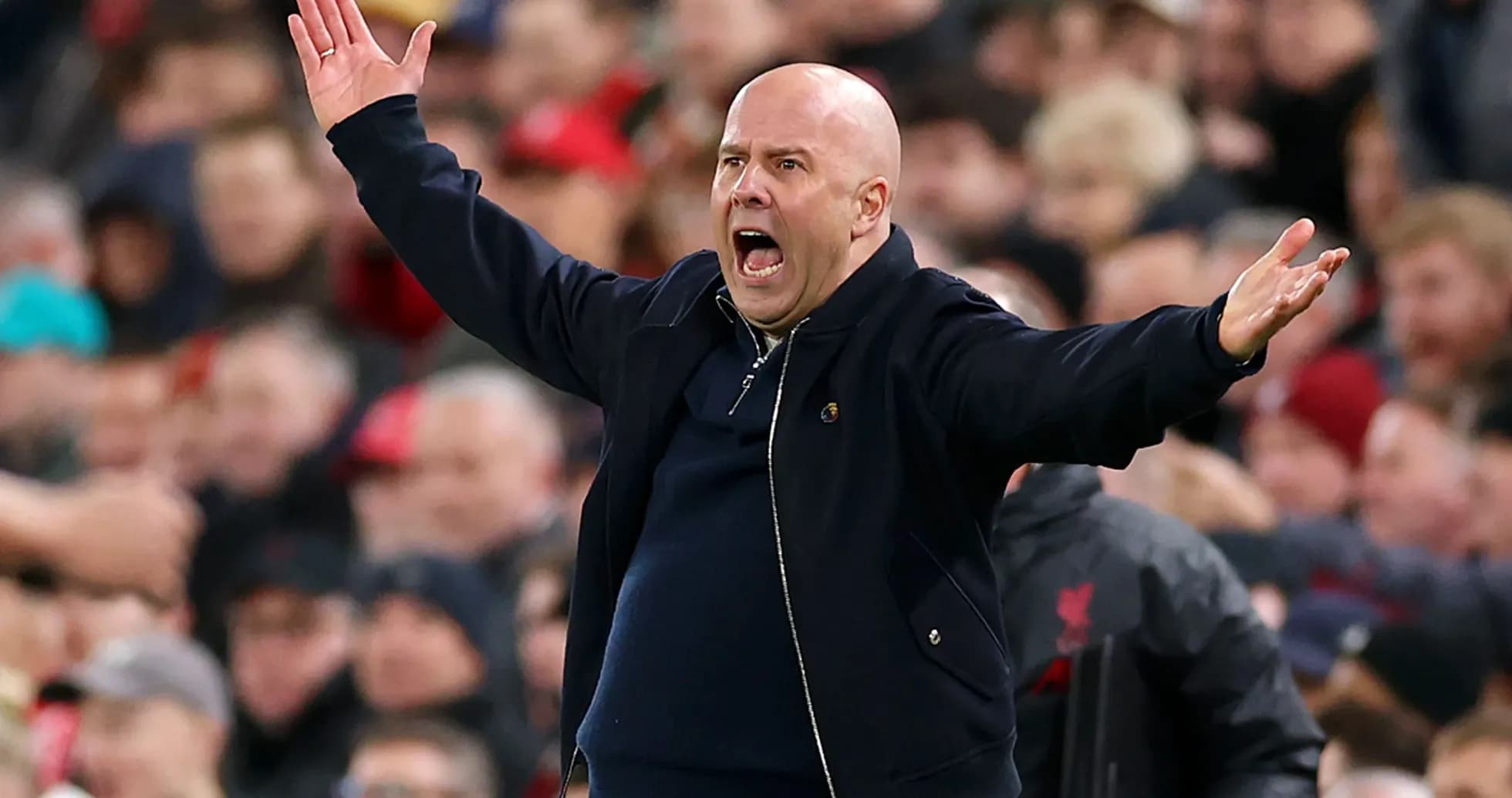
As the players walked the pitch in the traditional lap of appreciation, Slot stayed seated on the bench, expression fixed, arms folded. It may have been nothing more than a man lost in thought at the end of a draining campaign. It did not look like that from the stands.
The walk is supposed to be mutual. Players and staff thanking supporters for their backing; fans acknowledging the effort, even in a bad year. This was Slot’s chance to show he understood that bond, to step into it. He stayed apart instead.
Salah, by contrast, understood the moment perfectly. Speaking to Sky Sports, he cut to the heart of what matters at Liverpool: “They [the fans] don’t care that much about the result as long as you sweat and give your blood here, they’ll love you forever.”
That is the unwritten contract at Anfield. Show up. Give everything. Walk through the storm together. This season, after the trauma of Diogo Jota’s death in pre-season and the emotional weight that followed, that message carried even more weight. The fans needed to feel that everyone was in it with them.
Too often, they did not.
Injuries, a small squad – and a manager who can’t have it both ways
In his post-match press conference, Slot was asked to sum up the season in one word. He chose “injury.”
On one level, it is understandable. Liverpool have been hit hard. But this is the same manager who, back in October, proudly backed the decision to go with a smaller squad.
“This is a decision we have made together,” he said then. “I completely believe in this, because if you have 25 [players] it’s very hard to manage your squad.”
You cannot celebrate a lean group in autumn and then spend the rest of the season lamenting the lack of options, the strain of midweek and weekend football, the late goals conceded when legs and minds are tired.
The reality of the modern game is brutal. An expanded Champions League, a relentless Premier League, domestic cups that still matter. Bigger squads are not a luxury; they are a necessity. If you start the season knowing some new signings cannot play 90 minutes twice a week, you either carry more depth or you accept the consequences.
Liverpool did neither.
Slot spoke glowingly of his group in October: “I like my squad so much. But we don’t have 25 or 26 [players], so if we end up with two, three or four injuries, 15 or 16 players, where Rio and Trey are two of these 15 or 16, then need to play almost all the minutes and then things can become complicated.”
Trey Nyoni, the highly rated teenager who debuted at 16 under Klopp, finished the league season with just 21 minutes. Federico Chiesa, marginalised again, played 318 league minutes. Wataru Endo managed only 170.
Kieran Morrison, Under-21s captain and player of the season, was named on the bench 13 times. He played just five minutes, in an FA Cup tie at Wolves.
So the squad was not only small on paper. In practice, it was even smaller, with several players barely trusted. That is before you reach the baffling decision not to bring Harvey Elliott back to Anfield in January, despite the obvious need for quality from the bench in the second half of the campaign.
Injuries hurt Liverpool. So did choices.
Heavy defeats, high standards
Slot has pointed out that Liverpool’s 4-0 exits in both the FA Cup and Champions League came against high-class opposition: eventual FA Cup winners Manchester City and a PSG side that has not lost a two-legged European tie in two seasons.
That line will not travel far on Merseyside.
This is a fanbase that has watched its team stand toe-to-toe with Europe’s best and win. Being thrashed 4-0, even by elite sides, does not fit the identity Klopp built or the standards Virgil van Dijk, Robertson, Salah and Curtis Jones have all publicly demanded.
All four have been clear: this season fell below what Liverpool Football Club should accept.
Salah’s parting words to his team-mates at the AXA Training Centre cut through the noise: “Being in Liverpool, winning something for Liverpool and winning games is the best thing that could happen to you all.”
Slot, for his part, has called Champions League qualification “our lowest base,” and pointed to Chelsea and Tottenham missing out on Europe altogether as evidence of how hard it is at the top. To some supporters, that sounds like the bar being nudged down, not raised.
Liverpool are not supposed to measure themselves against who failed. They are supposed to measure themselves against who won.
Even the season’s best spell came with caveats. A 13-game unbeaten run followed a humiliating 4-1 home defeat to PSV, arguably the nadir of the campaign. Yet that run itself was littered with warning signs: draws against Leeds (twice), Burnley and Fulham, plus wins over Barnsley in the FA Cup and a West Ham side that would go on to be relegated.
The numbers flattered. The performances did not.
Transition, uncertainty – and a squad on the brink of another overhaul
The word around Anfield is “transition.” It has been for a while. It will be again this summer.
Slot has one year left on his contract. So do key decision-makers Richard Hughes and Michael Edwards. All three could, in theory, be gone in 12 months. That is a fragile platform on which to rebuild a squad.
And this squad will need surgery.
Up to nine first-team players could depart. Salah and Robertson are already on their way. Ibrahima Konaté is out of contract. Chiesa and Endo are expected to be available. Curtis Jones, with only a year left and strong interest from Inter Milan, is widely expected to move on. Alisson is wanted by Juventus. Joe Gomez, another entering his final year, could be sold. Alexis Mac Allister may be sacrificed for the right offer.
If even a majority of those moves happen, Liverpool will go into next season with Cody Gakpo as their leading current goalscorer for the club. Behind him? Centre-back Virgil van Dijk.
Slot has tried to calm the waters by insisting the coming window will not be as “drastic” as last summer. On the evidence of who is leaving and who might follow, that sounds optimistic.
The truth is harsher: this squad needs major work, in numbers and in quality.
As the players drifted down the tunnel and the stands slowly emptied, The Kop’s Bob Marley chorus lingered in the air. “Don’t worry about a thing…”
Nobody believed it. Not this time. Not after this season. Not with this much at stake.
For the first time in a decade, Liverpool head into the summer with a serious question hanging over them: is this just another transition, or the start of another long, grey era they thought they had left behind?